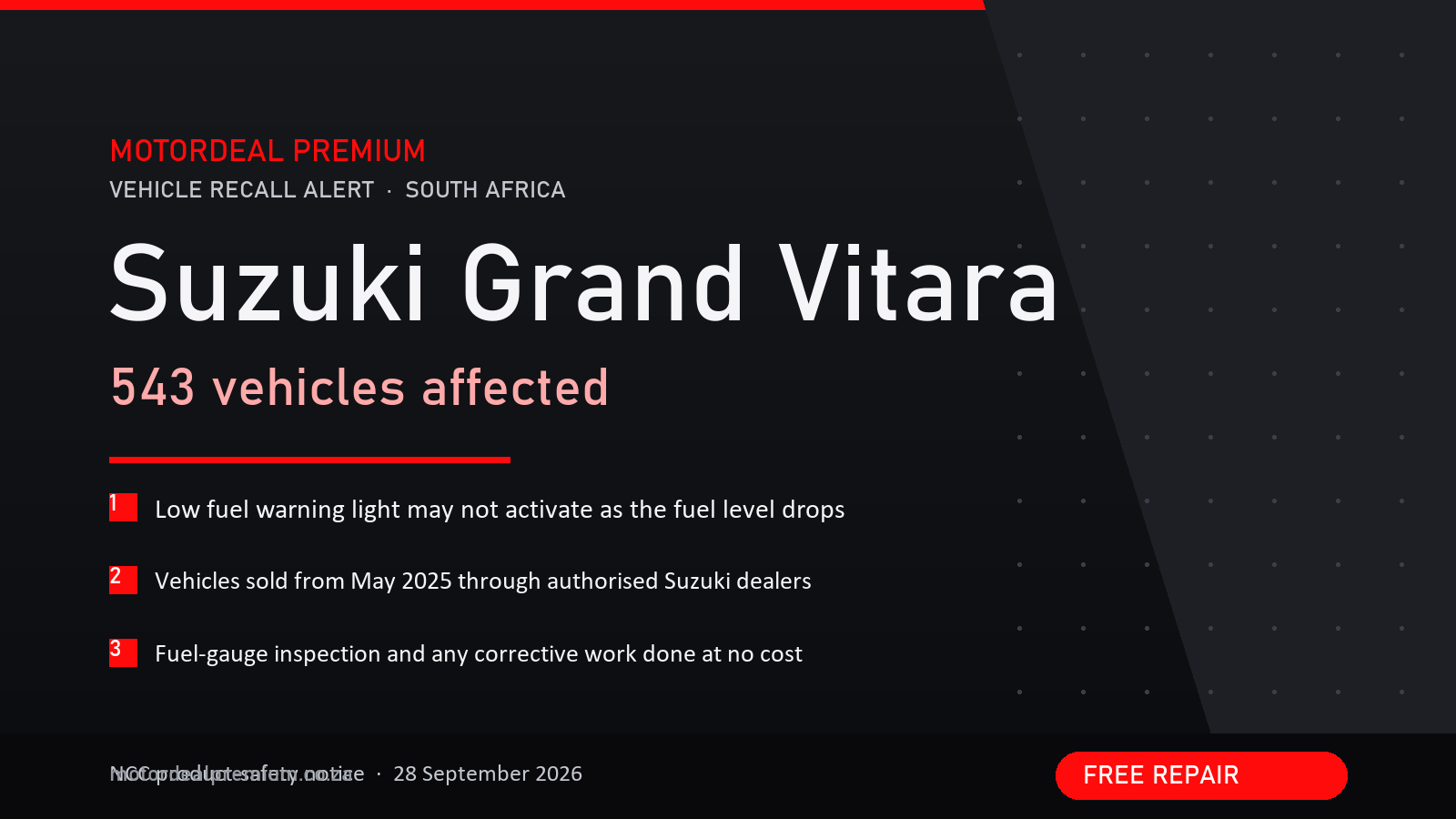
Answer first: Suzuki Auto South Africa Motors (Pty) Ltd is recalling 543 Grand Vitara vehicles in South Africa because the low fuel warning light may not turn on as the fuel level drops. The driver may not be alerted that fuel is running low, which could lead to the vehicle running out of fuel, the engine stalling and the car not restarting. The National Consumer Commission (NCC) says affected owners should take the vehicle to an authorised Suzuki dealership for a fuel-gauge inspection — any corrective work is done at no cost.
Recall at a glance
Model: Suzuki Grand Vitara
Vehicles listed in South Africa: 543
Sales period stated: made available from May 2025 through authorised Suzuki dealerships nationwide
Fault: The low fuel warning light may not activate as the fuel level decreases
Consequence: The driver may not be warned about low fuel; the vehicle can run out of fuel, stall and fail to restart
Owner action: Take the vehicle to an authorised Suzuki dealer for a fuel-gauge inspection; corrective work is free
What is the Suzuki Grand Vitara recall?
The National Consumer Commission product-safety notice, published on 28 September 2026, says Suzuki Auto South Africa Motors notified the regulator that 543 Grand Vitara vehicles are affected by a fault with the low fuel warning light. The recall covers units that were made available for sale through Suzuki dealerships nationwide from May 2025.
This is a current-year model campaign, not a wide-ranging body-style or engine recall. The NCC notice does not publish the full VIN range, so the reliable way to confirm whether a specific vehicle is listed is through the authorised Suzuki dealer network.
What can go wrong with the fuel warning?
The low fuel warning light is the driver’s main early signal that fuel is running low. According to the NCC, on affected vehicles this light may not turn on as the fuel level decreases. That means the driver may not receive the usual warning before the tank empties.
The practical risk is running out of fuel, which can cause the engine to stall — and, in some cases, prevent the vehicle from restarting. On a highway, in the heat, or in a remote area, an unplanned fuel-related stall is a safety and roadside-assistance issue, not just an inconvenience.
Safety note: Until your vehicle is inspected, do not rely on the warning light as your only fuel indicator. Monitor the fuel gauge, plan refuelling earlier than usual, and carry an appropriate amount of fuel for your route. Do not attempt to remove the instrument cluster, rewire the warning circuit or bypass the fuel system yourself — that is a fault for the authorised dealer to check and correct.
How to check and act if you own a Grand Vitara
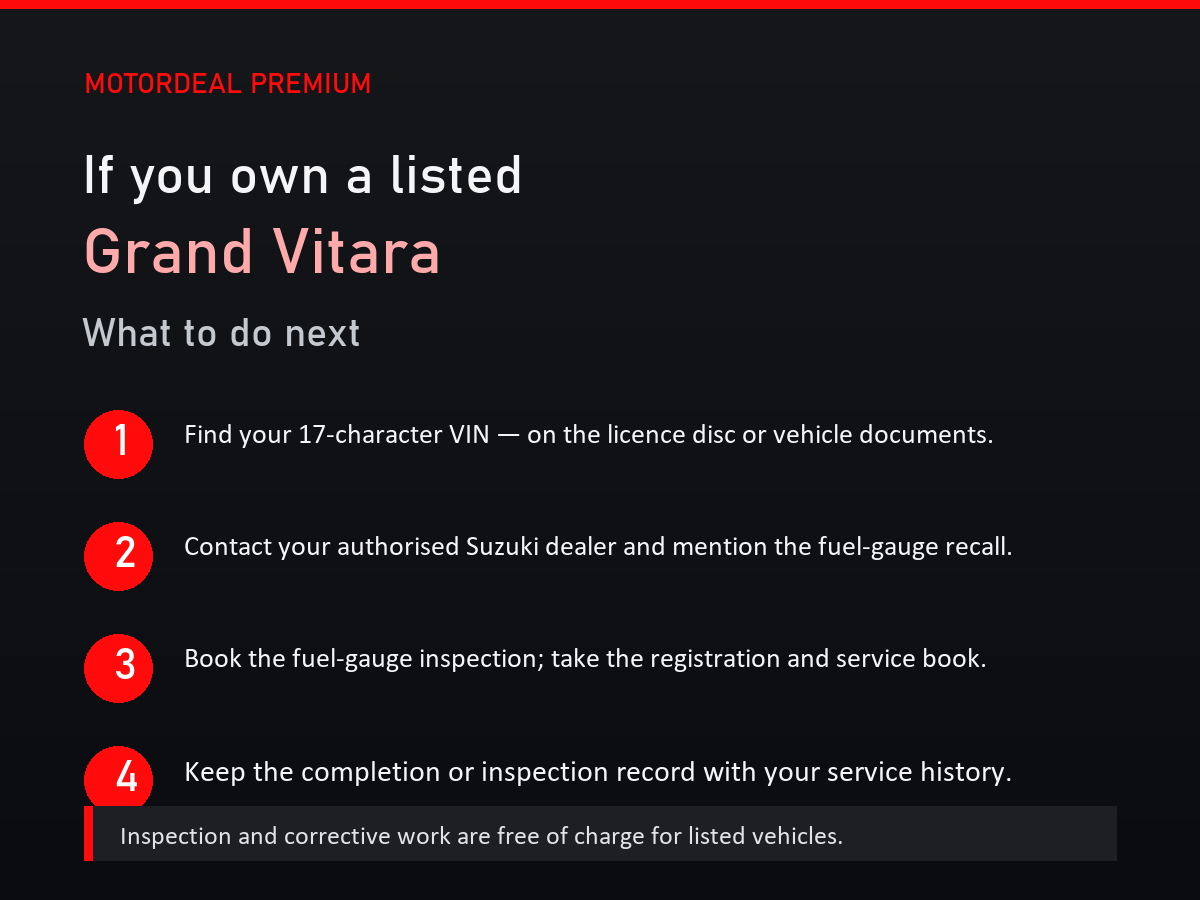
Confirm the model and build year. This campaign covers Grand Vitara vehicles made available from May 2025. If you own a current Grand Vitara, treat it as potentially in scope until a dealer confirms otherwise.
Contact your authorised Suzuki dealer. Use the Suzuki South Africa dealer locator to find the nearest authorised dealership. Give them the registration and VIN and mention the NCC low-fuel-warning recall.
Book the fuel-gauge inspection. The NCC says the dealer will inspect the fuel gauge and, where necessary, carry out the corrective work.
Keep the record. Retain the inspection or completion document with the service history for future ownership, resale or trade-in checks.
Four practical steps for listed Grand Vitara owners. Original graphic: Motordeal Premium Editorial Desk, based on the NCC notice dated 28 September 2026.
Will the inspection or repair cost the owner?
No. The NCC notice states that any corrective work will be performed at no cost to the consumer. Confirm the booking and what the inspection covers with the dealer, and take the registration, VIN and service book if you have them.
What if you are buying a used or demo Grand Vitara?
A recall does not automatically make a used vehicle a poor purchase, but an outstanding fuel-warning campaign is worth clarifying before you take delivery. Because the NCC notice does not list every VIN, ask the seller or dealer to confirm whether the specific vehicle has had the fuel-gauge inspection completed, and request the supporting record.
Pair that with the broader ownership file: service history, accident and repair records, tyres, brakes, roadworthy status and any finance settlement. Our Vanderbijlpark and Johannesburg showroom selection is a useful starting point when comparing quality vehicles, and buyers can review vehicle finance options before choosing a monthly-payment range.
What if you want to sell or trade in a listed Grand Vitara?
Complete the inspection where practical, or disclose the open campaign accurately and share the official dealer result with the buyer. Never represent the fuel-warning campaign as resolved without the supporting record.
If you are replacing the vehicle, request a Motordeal Premium trade-in assessment. Having the VIN, service book and any campaign paperwork ready makes the appraisal conversation quicker and clearer.
Why the fuel warning light matters
The low fuel warning light is a simple, reliable early-warning device: it tells you there is a usable reserve of fuel left before the tank is empty. When it is faulty, the driver loses that early signal and may only notice a fuel problem once the vehicle has already stalled. The recall addresses the warning, not the fuel system itself, so the fix is a gauge/signal check and correction rather than a major repair.
Owners are not expected to diagnose the fault in the driveway. A warning light that occasionally works is not proof the circuit is sound — the authorised dealer has the correct procedure and parts for the affected build.
What should you do if the light stops working?
If the fuel gauge or warning light behaves erratically, freezes, or fails to change as you use fuel, treat it as a sign to book the inspection. Avoid driving long distances or into remote areas until it is checked, refuel earlier than you would normally, and do not attempt to open the instrument cluster or modify the fuel circuit yourself.
The NCC notice says the recall covers 543 Grand Vitara vehicles made available for sale through authorised Suzuki dealerships in South Africa from May 2025. It does not publish the full VIN range, so an authorised dealer is the reliable way to confirm a specific vehicle.
Is the inspection free?
Yes. The NCC states the fuel-gauge inspection and any corrective work will be performed at no cost to the consumer.
Can I keep driving the vehicle until it is inspected?
The fault affects the warning light, not the fuel system or steering. You can continue to drive, but do not rely on the warning light as your only fuel indicator — refuel earlier and avoid long or remote journeys until the inspection is done.
What should I keep after the visit?
Keep the inspection or completion record with the service history. It helps with resale, trade-in and any future ownership queries.
Bottom line
If you own a current Suzuki Grand Vitara — or are buying or selling one — the useful next step is simple: contact your authorised Suzuki dealer, mention the NCC low-fuel-warning recall and book the free fuel-gauge inspection. Do not rely on a warning light that may not come on.
The practical NCO, RLV, NaTIS, roadworthy and handover checklist South African motorists need when selling a vehicle privately or preparing a trade-in.
The NCC has published draft guidance on product descriptions, sales records and price disclosure. Here are seven practical checks for South African car buyers.