South Africa has approved a move towards 10-year driving licence cards for many ordinary motorists, but the change is not yet active. Cabinet approved the policy in July 2026 and a draft regulation followed in August. Until final regulations and a commencement date are published, motorists should keep renewing under the current rules.
News explainer by the Motordeal Premium Editorial Desk. Information checked: 23 September 2026.
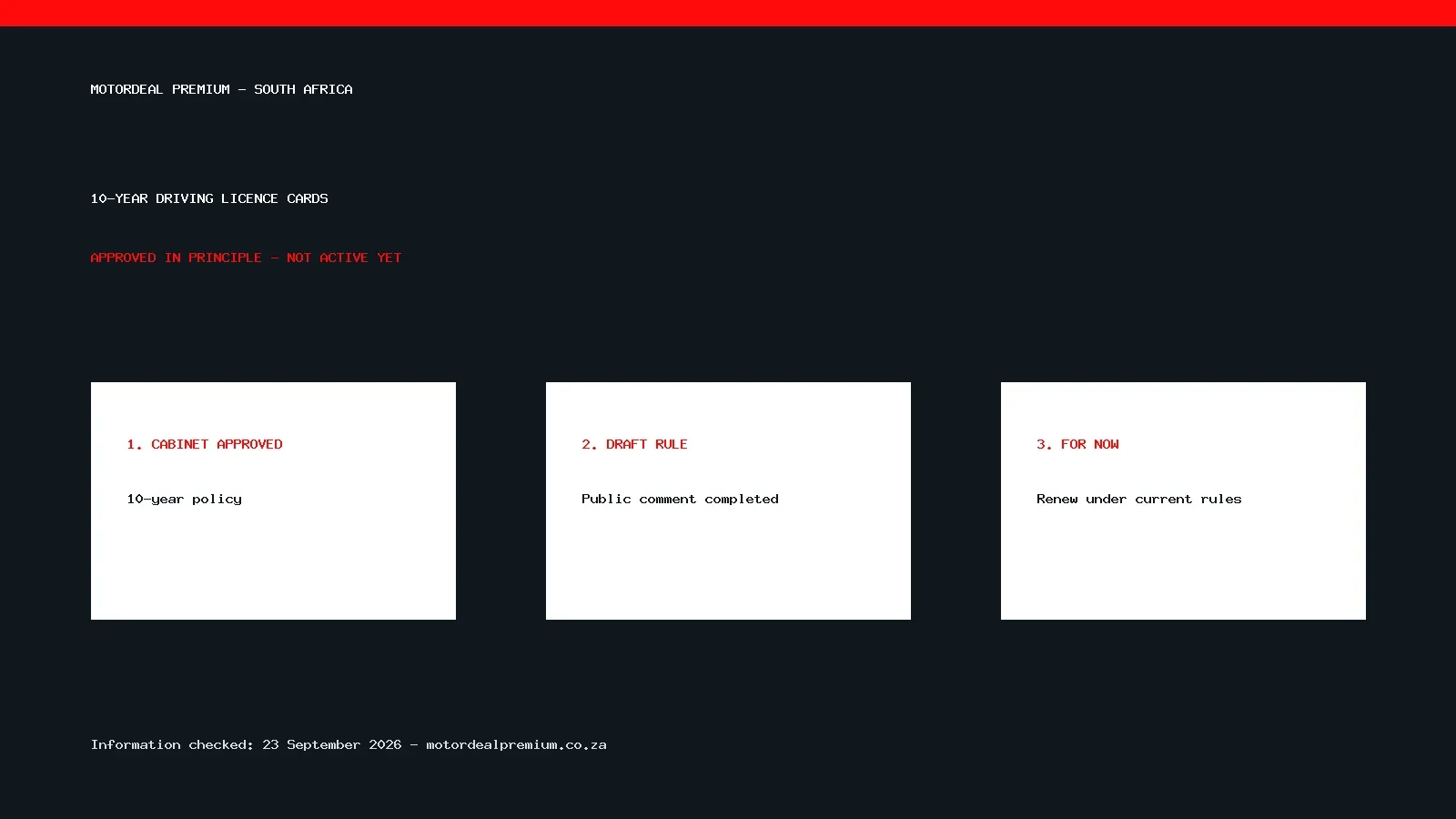
Original Motordeal Premium explainer graphic based on official government notices checked on 23 September 2026.
The status in one minute
Approved in principle: Cabinet approved extending the administrative validity of driving licence cards from five to 10 years for qualifying light-vehicle and motorcycle categories.
Drafted: Draft regulations published on 17 August 2026 proposed 10 years for categories A1, A, B and EB, while heavier vehicle categories would remain on a five-year cycle.
Not implemented yet: The 30-day public-comment period has now closed. At the time of this update, Motordeal Premium could not locate a final commencement notice that switches the public to the new cycle.
Action now: Treat the expiry date printed on your current card as operative and renew on time.
What exactly did government approve?
The policy separates ordinary light-vehicle and motorcycle categories from heavier vehicle categories. Under the draft wording, categories A1, A, B and EB would move to a 10-year card-validity period. Categories C1, C, EC1 and EC would remain valid for five years.
The Department also said professional driving permits would remain valid for two years and learner licences for 24 months. Those shorter cycles reflect the different responsibilities and risk profile attached to professional and learner driving.
This matters because headlines saying “10-year licences are here” can create the wrong impression. Cabinet approval is an important policy decision, but the operational rule still has to complete the regulatory process.
Why the change is not immediate
South African road-traffic rules are implemented through legislation and regulations, not a headline alone. The process normally involves publishing draft text, receiving public comments, considering those comments and then publishing a final rule with an effective date.
The draft was opened for comment for 30 days. That window has now passed, but a final notice is still the key document motorists need before changing their renewal behaviour. The final wording may also clarify how existing cards, transitional cases and the proposed replacement-card grace period will be treated.
What should drivers do right now?
Check the date on your card. Do not assume that Cabinet approval automatically adds five years to an existing card.
Apply before expiry. Government guidance says motorists should apply for renewal at a driving licence testing centre, with identity documentation, photographs where required and proof of residential address.
Complete the eye test and fingerprints. These remain part of the normal renewal process. An optometrist certificate may be accepted by the testing centre, but motorists should confirm local requirements before travelling.
Keep proof of the application. The government service page says a new card generally takes four to six weeks. Keep your receipt and collection details safe.
Ask about a temporary licence if needed. If your card has already expired, government guidance says you will need a temporary licence while waiting for the replacement and will pay the relevant additional fee.
Will your existing card automatically become valid for 10 years?
No official notice located for this update says that an existing five-year card automatically gains another five years. The safe approach is to follow the printed expiry date unless the Department of Transport publishes a clear transitional rule stating otherwise.
Does the proposal cover every driver?
No. The draft distinguishes between ordinary motorcycle and light-vehicle categories and heavier vehicle categories. Professional drivers, learner licence holders and holders of heavy-vehicle categories remain subject to different validity periods.
What could the longer period change?
For qualifying motorists, a 10-year card could mean fewer trips to a testing centre, lower renewal friction and less pressure on the card-production system. A practical policy question is how vision, address and identity details will be kept current between less frequent card renewals. The final implementation rules should clarify the supporting controls.
Practical advice for buyers and sellers
A driving licence card is not proof that a vehicle is roadworthy, fully paid up or legally owned by the seller. When buying a used car, still verify the vehicle, paperwork, service history and finance position independently. You can browse Motordeal Premium vehicles, review finance options, request a trade-in assessment or contact the team for help.
Frequently asked questions
Is the 10-year driving licence card already in force?
Not according to the official material available on 23 September 2026. The policy was approved and draft regulations were published, but motorists still need a final implementation notice and effective date.
Should I delay a renewal that is due now?
No. Renew under the current system. Waiting on the assumption that the new period will apply could leave you with an expired card.
Will I need to take the driving test again?
Normal card renewal does not require another practical driving test. The renewal process includes identity checks, fingerprints and an eyesight assessment.
Will professional driving permits last 10 years?
No. The Department said professional driving permits would remain on a two-year validity period.
Have a question about how the proposed rule could affect you? Follow the discussion on the Motordeal Premium Facebook page. We will update this explainer when a final commencement notice is published.
The NCC has published draft guidance on product descriptions, sales records and price disclosure. Here are seven practical checks for South African car buyers.