Answer first: when you sell a car in South Africa, the seller should complete and submit the Notification of Change of Ownership (NCO), while the buyer must register the vehicle in their name within 21 days using the Application for Registration and Licensing of Motor Vehicle (RLV). The buyer will generally need the registration certificate, a current roadworthy certificate, identification and proof of address. If a bank is still the titleholder, contact it before accepting a deal.
Vehicle Advice | Motordeal Premium Editorial Desk Information checked: 25 September 2026
This checklist separates the legal transfer steps from the practical handover items that protect both parties. Requirements and fees can differ by registering authority, so confirm the final checklist with your local licensing office before the transaction.
What documents do you need to sell a car in South Africa?
Prepare these items before meeting a buyer:
Original vehicle registration certificate: check that the vehicle, owner and titleholder details are correct.
NCO form: the yellow Notification of Change of Ownership form records the seller, buyer and vehicle details.
Buyer and seller identification: use valid South African identity documents or the documents required for foreign nationals or organisations.
Proof of residential address: the government guidance says the buyer should provide proof of address; if a utility bill is not in their name, the person named on it may need an affidavit confirming residence.
Current roadworthy certificate: the buyer needs this for registration. Do not assume that a licence disc alone proves roadworthiness.
RLV form: this is the buyer’s application to register and license the vehicle in their name.
Written sale agreement: record the parties, price, payment method, VIN, registration number, mileage, condition disclosures and handover date and time.
Handover record: list the keys, manuals, service records, accessories and documents transferred with the vehicle.
Download the official NCO form and RLV form from eNaTIS. Print clearly and avoid corrections that make the documents difficult to verify.
Step 1: Check who legally owns the vehicle
Look at the registration certificate before advertising. The owner is normally the person who uses or possesses the vehicle, while the titleholder is the person or institution with the legal title. On a financed vehicle, the bank may remain the titleholder until the account is settled and the release process is completed.
If the vehicle is financed, ask the lender for a current settlement figure and its exact sale or trade-in process. Do not promise the buyer immediate transfer until you know what the titleholder requires. If you are replacing the vehicle, compare the settlement amount with the trade-in offer and the amount you can contribute before applying for new vehicle finance.
Step 2: Match every number before signing
Compare the VIN and registration number on the vehicle with the registration certificate, sale agreement, NCO and RLV forms. Also record the odometer reading at handover. A single incorrect digit can delay registration or create a dispute later.
The VIN is usually visible through the lower windscreen and on a manufacturer plate or body stamping. Never alter, cover or re-stamp a VIN. If the numbers do not match, stop the transaction and resolve the discrepancy through the appropriate authority.
Step 3: Use a written vehicle sale agreement
A practical agreement should state:
full names, identification details and contact information for both parties;
vehicle make, model, VIN, registration number and recorded mileage;
purchase price, deposit if any, and how the balance will be paid;
known defects and accessories included in the sale;
the exact date and time that possession, keys and risk pass to the buyer;
who is responsible for roadworthy testing, licensing fees and transport; and
signatures of both parties, with each keeping a complete copy.
Describe the vehicle honestly. A vague “voetstoots” line is not a substitute for disclosing known faults, and it does not automatically override every legal right or obligation. If the transaction is unusual, disputed or high-value, obtain independent legal advice.
Step 4: Verify payment — not just proof of payment
Do not release the vehicle because someone shows you an SMS, email or banking-app screenshot. Confirm that the money has cleared in the account through your own bank channel. Be cautious about overpayments, refund requests, third-party payments and urgent collection arrangements.
Never share a one-time PIN, banking password or remote-access code. If the payer’s name differs from the buyer’s, pause and verify the reason before proceeding. For a financed purchase, confirm the payout process with the finance provider or dealership.
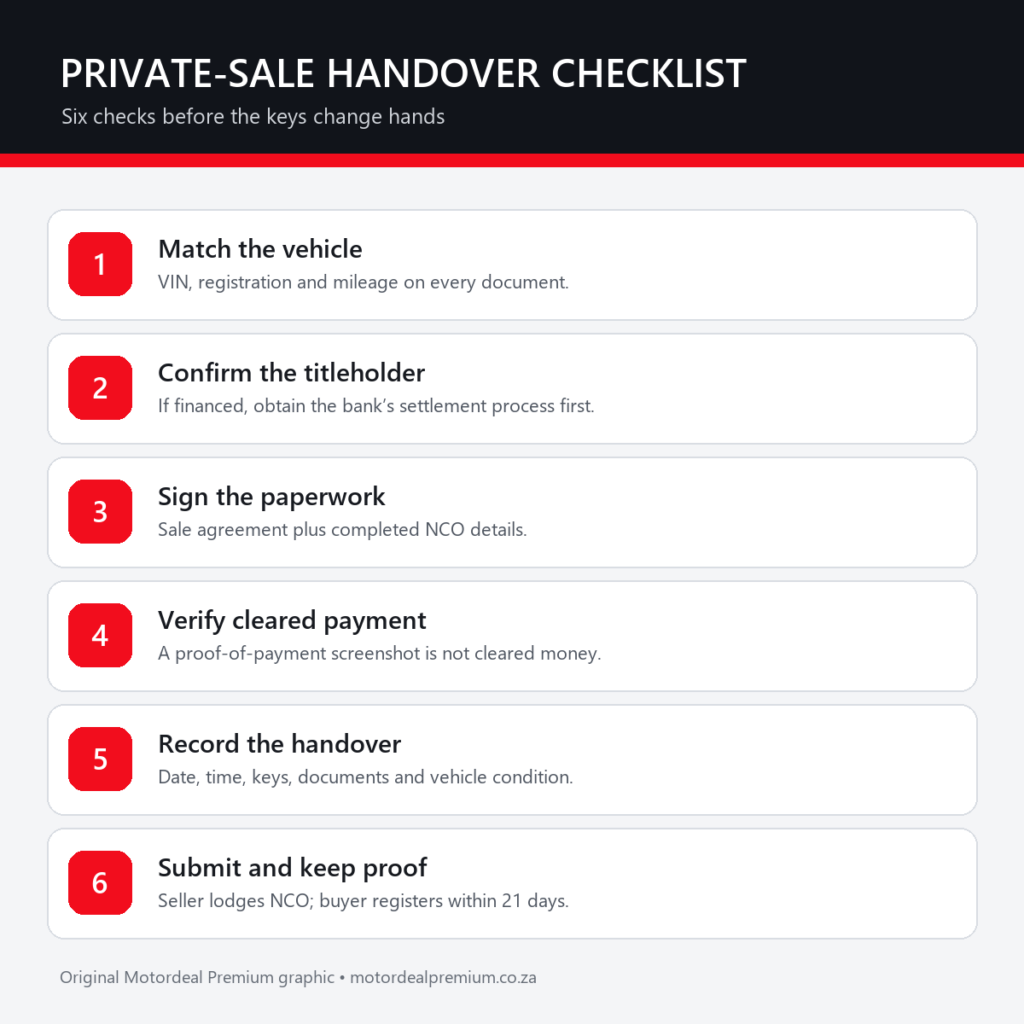
Original Motordeal Premium graphic: six checks before the keys change hands.
Save this checklist for handover day. For more practical vehicle guidance, follow Motordeal Premium on Instagram at @motordeal_premium and @motordealpremium, or join us on Facebook.
Step 5: Complete the NCO and submit it yourself
The South African Government’s change-of-ownership guidance says the seller must complete the NCO form and submit it to the registering authority. Do not leave the only completed copy with the buyer and assume it will be handled.
Complete the seller, buyer and vehicle sections carefully.
Make copies or clear scans of the signed form and supporting documents.
Submit the NCO to the appropriate registering authority.
Keep dated proof of submission with the signed sale agreement and handover record.
This paper trail helps show when the vehicle left your possession. It is especially important if fines, toll activity, an incident or a licensing query occurs after handover.
Step 6: The buyer must register the car within 21 days
The official government service page says the buyer must register the vehicle in their name and submit the RLV form within 21 days of the change of ownership. The buyer should take the registration certificate, identity and address documents, a current roadworthy certificate and the applicable fee to the registering authority.
If the buyer misses the deadline, penalties may apply. Sellers should therefore provide accurate documents promptly, while still keeping copies for their own records.
Step 7: Record the physical handover
Walk around the vehicle together and note its visible condition. Photograph the exterior, interior, odometer and fuel level with the buyer’s consent. Then record:
the handover date and exact time;
the number of keys and remotes supplied;
service books, invoices, manuals and wheel-lock keys;
spare wheel or mobility kit, warning triangle and accessories;
any known warning lights, defects or agreed repairs; and
who arranged insurance and collection.
The buyer should arrange insurance before driving away. The seller can then contact their insurer about cancelling or changing cover from the agreed handover point.
Private sale or trade-in: which is simpler?
A private sale may achieve a different price, but the seller carries the advertising, screening, payment and paperwork burden. A reputable dealership trade-in can consolidate the valuation, settlement and replacement-vehicle process, although the offer must still be assessed against your settlement and next-car budget.
Waiting for the buyer to submit the NCO: the seller should lodge it and retain proof.
Using inconsistent details: names, VIN, registration and dates must match across documents.
Handing over on a payment screenshot: verify cleared funds independently.
Ignoring the titleholder: a financed vehicle cannot be treated like a fully paid-up vehicle.
Leaving faults undocumented: write down known defects and agreed repairs.
Keeping no handover timestamp: record exactly when possession and keys changed hands.
Assuming requirements are identical everywhere: confirm fees and supporting documents with the buyer’s registering authority.
Frequently asked questions
Who submits the NCO form in South Africa?
The seller completes and submits the Notification of Change of Ownership to the registering authority. Keep proof of submission and a copy of the signed form.
How long does the buyer have to register the vehicle?
The buyer must register the vehicle in their name within 21 days of the change of ownership, according to the South African Government service guidance.
Can I sell a car that is still financed?
Yes, but the lender may still be the titleholder. Contact it first for a settlement figure and the required release or dealer-payment process. Do not try to bypass the titleholder.
What if the registration certificate is missing?
Resolve that before the sale. The registered titleholder should ask the registering authority about the duplicate-certificate process and required identification or affidavits.
Is a licence disc the same as a roadworthy certificate?
No. A licence disc shows the vehicle’s licensing status; a roadworthy certificate records a roadworthiness test. The government change-of-ownership checklist calls for a current roadworthy certificate when the buyer registers the vehicle.
This article provides general practical information, not legal or financial advice. Verify current requirements with your registering authority, titleholder, insurer and finance provider.
Have a vehicle-paperwork question? Send it to the Motordeal Premium community on Facebook, or follow @motordeal_premium and @motordealpremium for more South African motoring guidance.
The NCC has published draft guidance on product descriptions, sales records and price disclosure. Here are seven practical checks for South African car buyers.