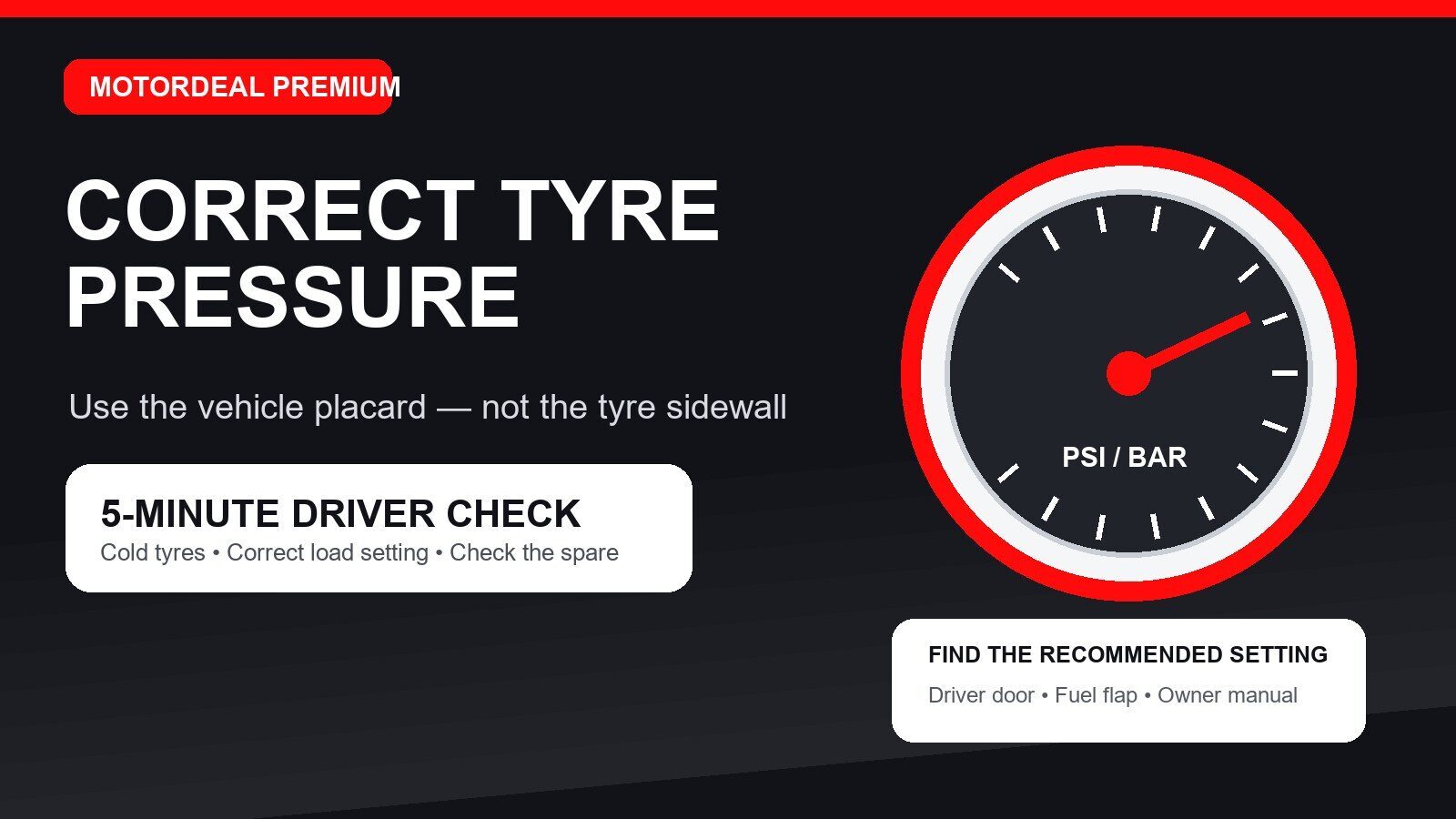
There is no single correct PSI or bar figure for every car. The right tyre pressure is the vehicle manufacturer’s setting for your exact model, tyre fitment and load. Find it on the label in the driver-door opening, inside the fuel flap or in the owner manual. Check the tyres when cold where practical, and do not use the maximum pressure moulded into the tyre sidewall as your everyday target.
Information checked: 26 September 2026.
Correct inflation supports predictable steering and braking, sensible tyre wear, ride comfort and fuel or energy efficiency. It is also one of the quickest owner checks you can do before a long trip or after a large change in weather.
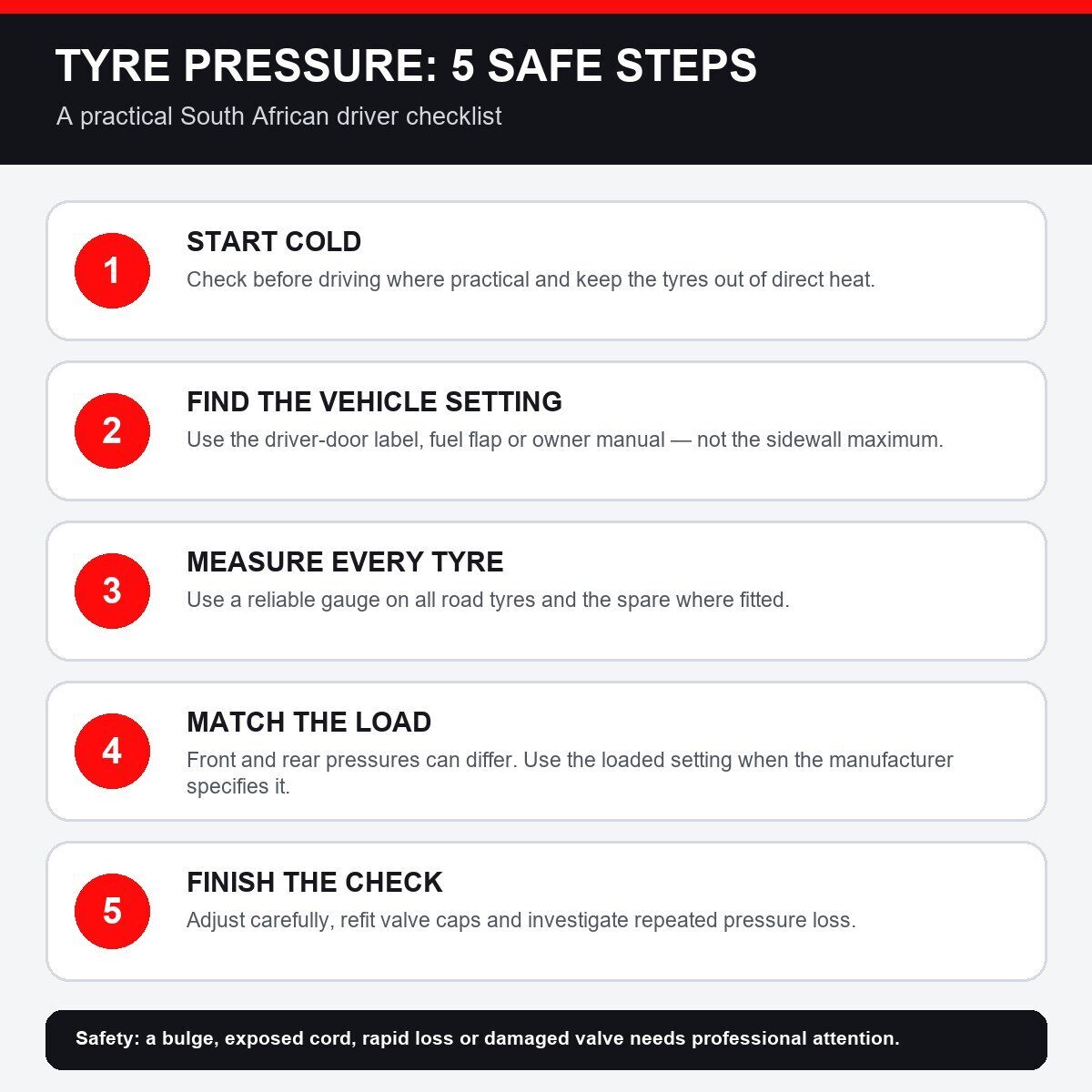
Five safe tyre-pressure steps. Original graphic: Motordeal Premium.
Where do I find the correct tyre pressure for my car?
Start with the car, not the tyre. The manufacturer’s recommendation is usually shown in one or more of these places:
the driver-door jamb or door opening;
the inside of the fuel-filler flap;
the owner manual; or
the manufacturer’s verified owner-information service.
The label may show different figures for the front and rear axles. It may also give one setting for normal use and another for a fully loaded vehicle. Follow the row that matches the fitted tyre size and the way the vehicle is being used.
Do not copy a pressure from another version of the same model. Wheel size, tyre specification, body style, drivetrain and loading can change the recommendation. If the label is missing or unreadable, ask the vehicle manufacturer, an authorised dealer or a qualified tyre professional to confirm the specification for the exact vehicle.
Why the number on the tyre sidewall is not your target
The pressure moulded into the tyre sidewall is not the vehicle’s everyday inflation recommendation. It relates to the tyre’s construction and limits, while the door or fuel-flap label is the vehicle engineer’s setting for the specific vehicle application.
Inflating every tyre to the sidewall figure can produce the wrong pressure for the car. Over-inflation can reduce the useful contact patch, make the ride harsh and encourage centre wear. Under-inflation can increase heat, rolling resistance and shoulder wear while making steering and braking responses less predictable.
How to check tyre pressure in five safe steps
1. Start with cold tyres
Check before driving where practical, after the vehicle has stood and before strong sunlight heats one side. Driving warms the tyres and raises the reading, so comparing a hot reading with a cold specification can mislead you.
If you have already driven to a petrol station, do not bleed warm tyres down merely because the reading is above the cold figure. Recheck them cold later. If a tyre is visibly low, damaged or losing pressure quickly, do not continue as normal—move to a safe place and get professional assistance.
2. Use a reliable gauge
Remove the valve cap, press the gauge squarely onto the valve and note the reading. A hiss usually means the gauge is not seated properly. Repeat the measurement if the result looks unusual, and compare it with the vehicle’s specified bar, kPa or PSI value.
3. Measure all road tyres and the spare
Check every tyre rather than judging pressure by appearance. Modern radial tyres can look normal while under-inflated. Check the spare where fitted, including space-saver spares that may require a very different pressure from the road wheels.
4. Adjust for the actual load
Use the manufacturer’s loaded setting when the placard or manual requires it for passengers, luggage or towing. Front and rear settings can differ, so work axle by axle rather than assuming all four tyres take the same pressure.
5. Refit the valve caps and investigate repeated loss
Replace every valve cap and record the readings if you are tracing a problem. A tyre that repeatedly needs air may have a puncture, damaged valve, rim leak or other fault. Adding air is not a repair.
A sensible routine is at least once a month and before a long journey, with extra checks after a major temperature change, after carrying an unusually heavy load, after striking a pothole or kerb, or whenever the car’s handling changes. Arrive Alive’s tyre-safety guidance recommends checking even more frequently—once a week or before a long journey.
Check the spare less often if the manufacturer allows, but do not forget it. A flat spare discovered at the roadside is no help.
Does the TPMS warning light mean I can skip manual checks?
No. A tyre-pressure monitoring system is a warning aid, not a replacement for regular checks. The light may only come on after pressure has fallen beyond a threshold, and some systems do not show the pressure of every tyre. Use the owner manual to understand your vehicle’s system and how to reset or recalibrate it after inflation or tyre work.
If the TPMS light flashes, remains on after pressures are correctly set, or returns repeatedly, have the system and tyres inspected. Do not disable the warning system.
When tyre pressure is a symptom of a bigger problem
Stop treating the issue as a routine top-up and arrange professional help if you find:
a sidewall bulge, exposed cord, deep cut or cracked valve;
rapid or repeated pressure loss;
a screw, nail or other object in the tyre;
uneven wear across the tread;
vibration, pulling or a sudden handling change; or
a pressure warning together with visible damage.
Safety warning: do not crawl under an unsupported vehicle, attempt a roadside wheel change in an unsafe position, or use a puncture sealant unless the vehicle and sealant instructions allow it. Sealant can be a temporary mobility measure, not proof that the tyre is safe for continued normal use. A qualified tyre technician should assess structural damage and repairability.
Common tyre-pressure mistakes
Using one “standard” PSI for every vehicle
There is no universal figure. Use the exact manufacturer specification for the vehicle, tyre fitment and load.
Checking only when a tyre looks flat
Appearance is not a reliable gauge. Measure with a proper pressure gauge.
Deflating a warm tyre to the cold target
Pressure rises as the tyre warms. Recheck cold rather than deliberately lowering a healthy warm tyre to the cold specification.
Ignoring the loaded-pressure row
A family trip, full luggage compartment or towing load may require a different setting stated by the manufacturer.
Assuming repeated top-ups are normal
Small natural losses happen over time, but frequent loss from one tyre needs investigation.
Quick tyre-pressure FAQs
Should front and rear tyre pressures be the same?
Not necessarily. Many vehicles specify different front and rear figures. Follow the axle-specific values on the placard or in the manual.
Should I use bar, kPa or PSI?
Use whichever unit appears on the vehicle label and your gauge. Avoid mental conversion at the pump if the gauge can switch units. As a sense-check, confirm that you are reading the correct unit before adding air.
What if my replacement tyres are a different size?
Do not guess. Confirm that the fitment is approved for the vehicle and obtain the correct inflation guidance from the vehicle or tyre manufacturer and a qualified fitment professional.
Does nitrogen change the correct pressure?
No. The vehicle still needs the manufacturer’s recommended pressure, and nitrogen-filled tyres still need regular checks.
The practical NCO, RLV, NaTIS, roadworthy and handover checklist South African motorists need when selling a vehicle privately or preparing a trade-in.
The NCC has published draft guidance on product descriptions, sales records and price disclosure. Here are seven practical checks for South African car buyers.