Red Brake Warning Light On? Stop Safely and Check This
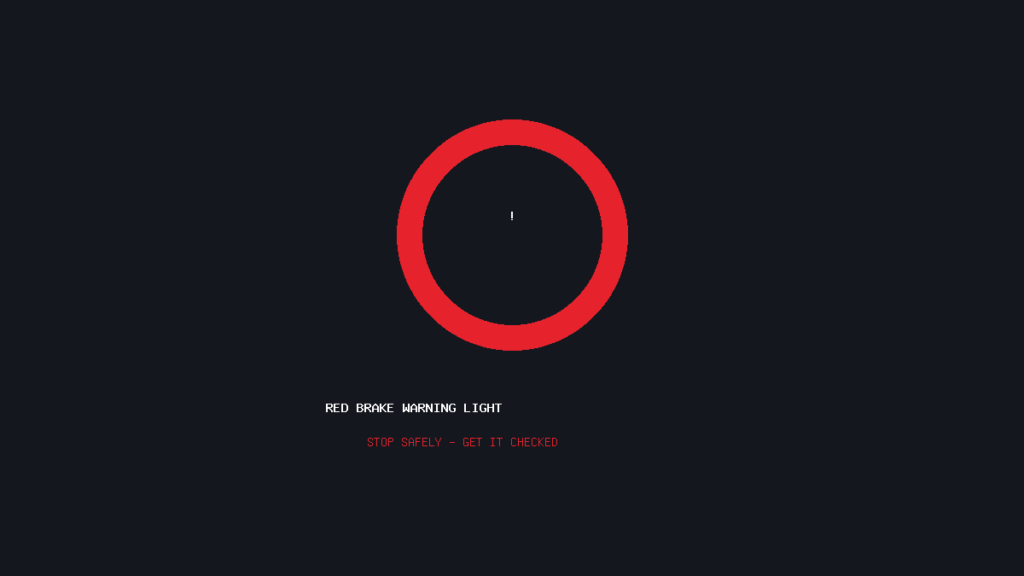
A red brake warning light needs immediate attention. If it remains on after the parking brake is fully released, stop as soon as it is safe. It may indicate low brake fluid or a hydraulic braking fault. Do not keep driving simply because the pedal still feels normal.
Information checked: 24 October 2026. General guidance only; your vehicle manual takes priority.
What to do immediately
- Ease off the accelerator and avoid abrupt inputs.
- Move to a safe, level stopping place away from traffic.
- Apply the parking brake once stationary, select Park or a low gear, and switch off.
- Confirm that the parking brake is fully released.
- If the warning remains on or returns, arrange professional diagnosis.
When you must not drive
Arrange roadside assistance or recovery if the pedal feels soft, spongy, unusually hard or travels farther than normal; braking performance has changed; fluid is visible beneath the car; the reservoir is below MIN; there is grinding, pulling or a burning smell; or the red light stays on with the parking brake released.
Safety warning: never test questionable brakes at speed. Do not crawl under a vehicle supported only by its jack, and do not open brake pipes or bleed the hydraulic system without the correct training and equipment.
Can you check the brake fluid?
You can make a visual owner check if the reservoir is accessible and the car is safely parked on level ground. Use the vehicle manual to identify the reservoir. Keep the engine off, let hot parts cool, and view the level through the translucent reservoir against the MIN and MAX marks.
Do not open the cap merely to inspect the level. Brake fluid absorbs moisture and damages paint. A low level may reflect worn pads, but can also indicate a leak. Topping up without diagnosing the cause can hide a dangerous fault. Use only the exact fluid specification stated by the manufacturer.
Red brake light versus amber ABS light
The red warning relates to the parking brake or primary braking system on many vehicles. The amber ABS light indicates a detected anti-lock braking fault. Normal braking may remain available with an ABS fault, but wheel-lock prevention and related stability functions may not operate. Follow the warning-light section in your manual.
Read our separate South African ABS warning-light guide.
Used-car check
Warning lamps should illuminate briefly during the ignition self-check and then go out as specified by the manufacturer. A lamp that never illuminates can be as concerning as one that stays on. Ask for diagnosis rather than accepting a dashboard reset as proof of repair.
Browse our showroom, review finance options, request a trade-in assessment, or contact us.
Quick answer
If the red brake warning stays on after the parking brake is released, stop safely and arrange professional diagnosis. Adding fluid or restarting the car does not prove that the fault is repaired.
Follow @motordeal_premium and @motordealpremium on Instagram. Join Motordeal Premium on Facebook for more practical motoring guides.
Sources
- AA South Africa: dashboard warning lights
- Vehicle manufacturer owner manuals: braking-system and warning-light sections.
- South African Government: National Road Traffic Act