Warning Triangle Rules in South Africa: Where to Place It
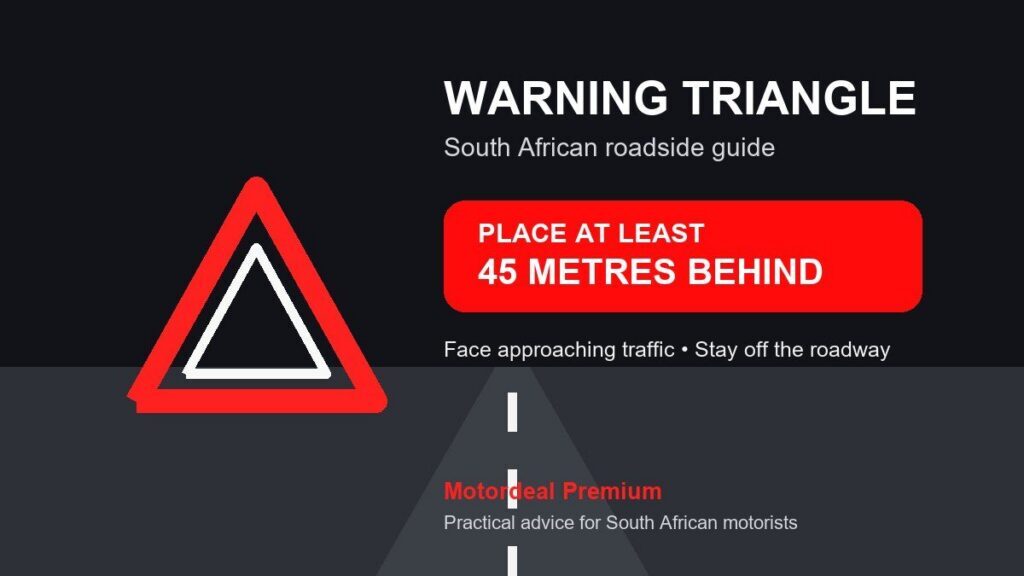
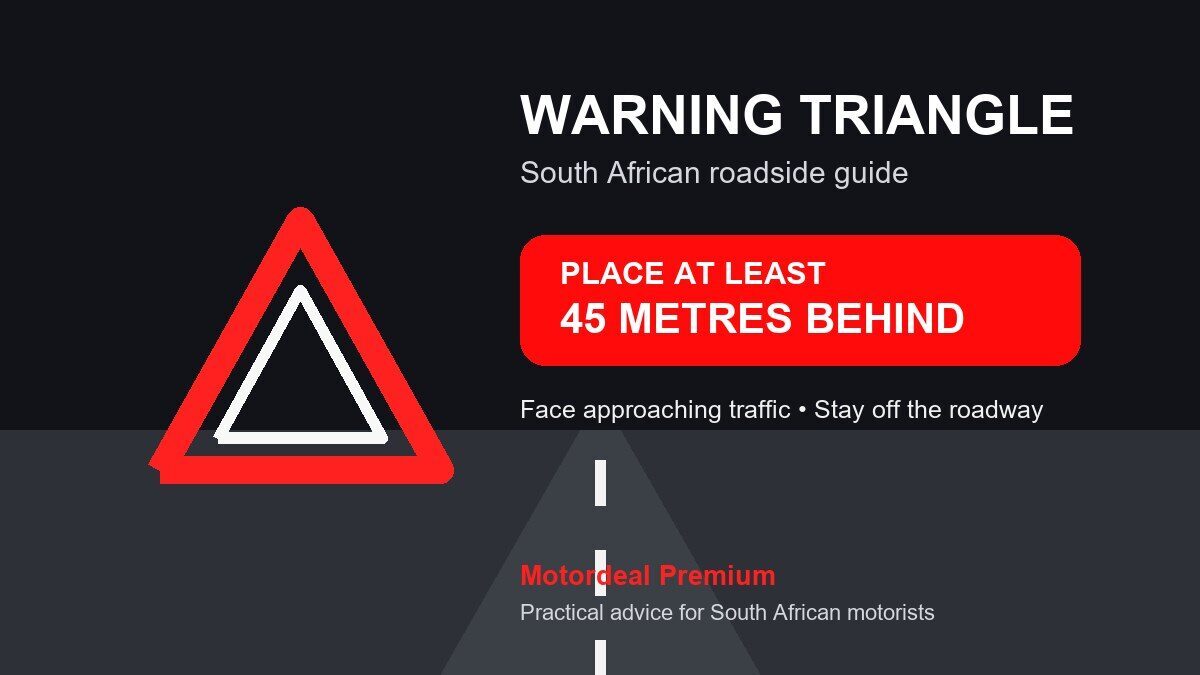
If your vehicle is stationary on a public road because of a breakdown or emergency, place a warning triangle at least 45 metres behind it, facing approaching traffic. Switch on your hazard lights too, move as far out of the traffic lane as safely possible, and keep people away from moving vehicles.
What is the South African warning-triangle rule?
Regulation 214 of the National Road Traffic Regulations deals with vehicles stationary on the roadway. In the circumstances covered, the prescribed red triangle must be displayed at least 45 metres behind the vehicle, with its red retro-reflective side facing traffic approaching from behind. The regulation contains vehicle-specific detail and exceptions, so consult the official text for the complete legal wording.
How to place it safely
- Stop as far from live traffic as possible. If the vehicle can move safely, use a shoulder, parking area or protected position.
- Switch on the hazards. They help, but do not replace the triangle.
- Check before opening a door. Where possible, exit on the side away from traffic and keep passengers behind a barrier or well off the road.
- Walk on the safest available side. Watch approaching traffic continuously and carry the triangle close to your body.
- Set it at least 45 metres behind the vehicle. Face the reflective red side towards approaching traffic and make sure it is stable and visible.
- Return to a protected position. Never wait between the triangle and the vehicle.
How far is 45 metres?
It is roughly the length of ten average passenger cars parked nose to tail, although vehicle lengths vary. Practise estimating it in a safe car park. Do not rely only on counting steps because stride lengths differ.
The legal minimum does not always guarantee enough warning at motorway speeds, near a blind bend or over a crest. More warning may help, but never walk into a dangerous position merely to increase the distance.
What if the shoulder, bend or hill is dangerous?
Your personal safety comes first. If normal placement would expose you to high-speed traffic, a narrow bridge or another immediate danger, move to a protected place and call roadside or emergency assistance. Do not stand in the road directing traffic.
The Automobile Association advises people arriving first at a crash to assess danger before approaching and avoid becoming another casualty. Emergency responders may need to manage unusual or dangerous scenes.
Can hazards replace the triangle?
No. Hazard lights identify the disabled vehicle, while a correctly positioned triangle gives approaching drivers advance warning. Use both when appropriate.
Keep the triangle accessible
Do not bury it beneath a fully packed boot. Check that its stand opens, its reflective faces are clean and it is not cracked. A sensible kit can also include a reflective vest, torch, charged power bank, first-aid kit and roadside-assistance details.
When roadside DIY is too dangerous
Call qualified help if the vehicle is in a live lane, fuel is leaking, there is smoke or fire, someone is injured, steering or brakes are affected, or you cannot wait safely. Never crawl beneath a roadside vehicle, touch exposed EV or hybrid high-voltage components, or work beside moving traffic.
Before your next trip
Locate your triangle and open its stand today. If you are replacing your vehicle, browse our Vanderbijlpark showroom or contact Motordeal Premium.
Follow @motordeal_premium and @motordealpremium on Instagram. Join the discussion on our Facebook page: is your emergency triangle easy to reach?
Sources and information check
- National Road Traffic Regulations — official government PDF (Regulation 214).
- Automobile Association of South Africa: first on an accident scene.
Information checked: 29 October 2026. General road-safety information, not legal advice. Follow lawful instructions from emergency personnel.
Quick questions
How far behind a broken-down car should the triangle be?
At least 45 metres in the circumstances covered by Regulation 214, facing traffic approaching from behind.
Should it go in front too?
The core requirement addresses traffic from behind. Extra warning may help on an unusual road, but never expose yourself to traffic; leave dangerous scene control to trained responders.