Used Car Refund Ruling: Buyer Chooses the Remedy
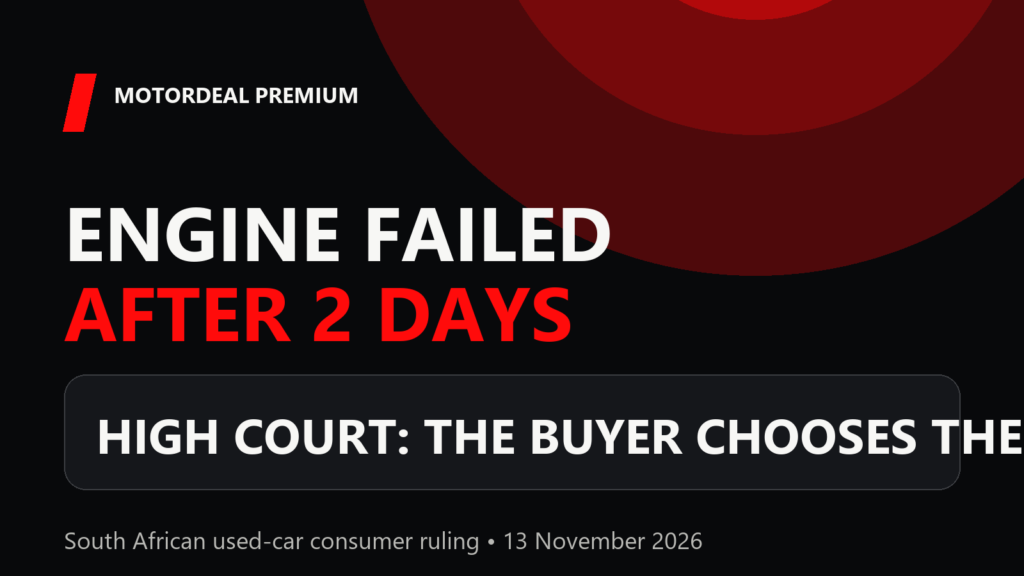
Used car refund ruling: what the WP Motors case means for buyers
Answer first: A South African dealer cannot choose a repair when a consumer has validly elected a refund under section 56(2) of the Consumer Protection Act (CPA). In WP Motors Sales v National Consumer Commission, delivered on 13 November 2026, the Gauteng High Court dismissed the dealer’s appeal after a used Ford Ranger suffered engine failure two days after purchase. The refund order of R276,607.49 and R200,000 administrative fine remained in place.
What buyers should remember
- Report a serious defect immediately and keep the message, towing record and diagnostic evidence.
- State your chosen remedy clearly in writing: repair, replacement or refund.
- The six-month period concerns returning defective goods; the High Court said it is not the deadline for lodging the later complaint.
- A used vehicle is not excluded merely because it is older or has mileage, but not every minor fault automatically justifies a refund.
What happened in the Ford Ranger case?
The consumer bought a used 2015 Ford Ranger on 17 January 2020 for a financed price of R276,607.49. The odometer reading recorded in the transaction was 115,567 km. On 19 January, during the vehicle’s first long-distance trip after purchase, the engine failed near Heidelberg.
The buyer emailed the dealer the next morning to say he was returning the bakkie, and then expressly asked for the transaction to be cancelled. The dealer refused the cancellation, attributed the failure to driver negligence and rebuilt the engine despite the consumer declining the repair.
The National Consumer Tribunal later found that the dealer had contravened sections 55(2)(b), 55(2)(c) and 56(2)(b) of the CPA. It ordered repayment of the purchase price and imposed a R200,000 administrative fine. The High Court dismissed the dealer’s appeal. The NCC’s late cross-appeal seeking a higher fine was not entertained, so the R200,000 penalty remained.
Who chooses between a repair and a refund?
Section 56(2) says that, within six months after delivery, a consumer may return goods that fail to meet the section 55 standards and direct the supplier to repair or replace them, or refund the price paid. The High Court found that the choice belongs to the consumer, not the supplier.
That does not mean every warning light, worn component or small defect produces an automatic refund. The defect and circumstances still matter. In this case the engine failure made the vehicle unusable within days, the vehicle was returned promptly, and the consumer repeatedly communicated the decision to cancel.
Does the complaint have to be lodged within six months?
The judgment rejected the argument that the buyer had to lodge the complaint with the NCC within six months of delivery. The court explained that the six-month period qualifies the right to return the goods. Here, the vehicle was returned and the refund was requested within days. The later referral was governed by the CPA’s separate prescription provisions.
This distinction is practical: act quickly when the fault appears, but do not assume that an unresolved dispute disappears merely because the ombud or regulator process continues beyond six months. Keep evidence showing when the defect arose, when the dealer was notified and when the vehicle was made available for return.
Can accepting a repaired vehicle cancel your refund claim?
The court did not accept that the buyer had abandoned the refund election merely because he later took possession of the repaired vehicle. The evidence showed that he continued pursuing cancellation through MIOSA and the NCC. The Tribunal had found that he accepted the vehicle under pressure after the dealer threatened storage charges.
The safer course is to avoid ambiguity. If a dealer repairs a vehicle after you elected a refund, repeat in writing that you have not changed your chosen remedy. Record why you collect or store the vehicle, and avoid signing wording that says the matter is settled unless that is genuinely your intention.
What should you do when a newly bought used car fails?
- Stop using the vehicle if continued driving could worsen the damage. Follow the owner’s manual and arrange safe recovery where necessary.
- Notify the dealer immediately in writing. Record the date, mileage, warning lights, symptoms, location and whether the vehicle can be driven.
- Preserve evidence. Keep the advert, offer to purchase, finance documents, roadworthy records, inspection reports, photographs, messages, towing invoices and job cards.
- State the remedy you want. If you believe the defect is serious enough to invoke section 56(2), say whether you elect repair, replacement or refund. Do not rely only on a phone call.
- Do not authorise major work casually. Ask for the diagnosis, proposed work, cost responsibility and effect on your chosen remedy in writing.
- Escalate a deadlock. Start with the dealer principal or complaints team, then follow MIOSA’s consumer complaint process. A potential CPA contravention may later be taken to the NCC in line with its complaint requirements.
Does this apply to private sales?
This ruling concerned a dealer transaction covered by the CPA. A once-off private sale may fall outside the Act when the seller is not supplying vehicles in the ordinary course of business. The contract, representations and common law may still matter, but the route can be different. Get individual advice where a major loss or disputed private sale is involved.
The practical lesson for buyers and dealers
For buyers, the strongest protection is fast, precise documentation: report the defect, preserve proof and state the chosen remedy. For dealers, a repair cannot simply be imposed when the consumer has validly elected another section 56(2) remedy. Both sides should distinguish a serious defect from routine wear, investigate with admissible technical evidence and keep the dispute process in writing.
For broader guidance, read our South African used-car consumer rights guide and use the used-car inspection checklist before committing to a purchase.
Sources
- WP Motors Sales (Pty) Ltd t/a WP Motors v National Consumer Commission and Others (A278/2025) [2026] ZAGPPHC 1293 (13 November 2026)
- National Consumer Commission: Tribunal refund and fine statement, 24 March 2025
- National Consumer Tribunal judgment NCT/246983/2022/73(2)(b)
- Consumer Protection Act 68 of 2008, sections 55 and 56
- MIOSA consumer complaint guidance
This article explains a reported judgment and general consumer steps. It is not individual legal advice, and outcomes depend on the facts and evidence of each dispute.