Driving over the Heritage Day long weekend? Spend 20 minutes checking the car before joining the busier routes. Gauteng road authorities warned on 23 September 2026 that traffic volumes were expected to rise from Thursday 24 September through Sunday 27 September, particularly on the N1, N3, N4, N12 and N14. The practical priority is simple: make the vehicle roadworthy, plan the route, secure every passenger and avoid driving tired, distracted or after drinking.
Information checked: 24 September 2026.
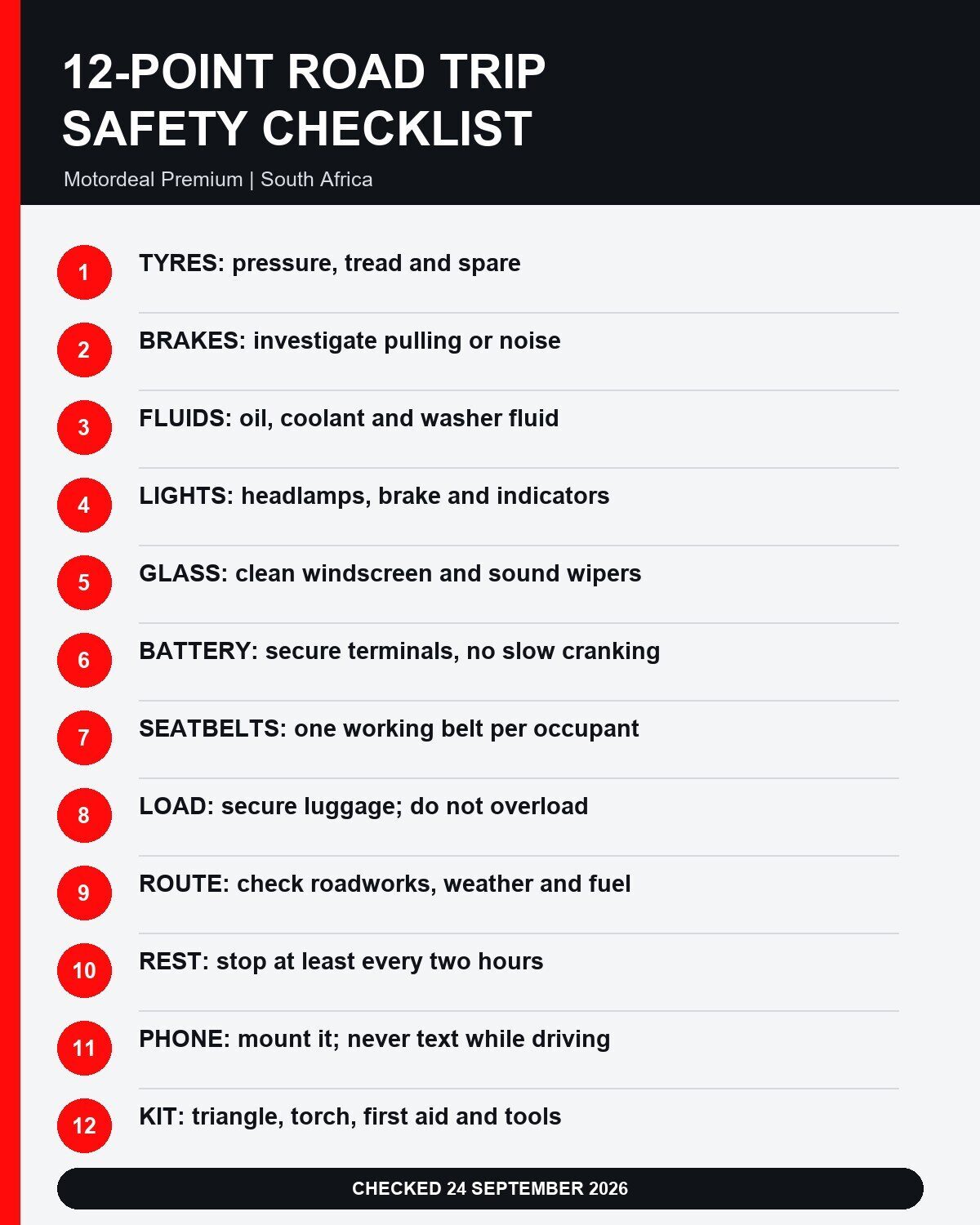
Save this original Motordeal Premium checklist before leaving. Credit: Motordeal Premium.
Heritage Day traffic: where extra planning matters
The Gauteng Provincial Government identified the N1, N3, N4, N12 and N14 as important high-volume routes for the long-weekend period. Even if your trip starts outside Gauteng, the same preparation applies: check live traffic and weather shortly before departure, allow extra time around toll plazas and major interchanges, and do not try to recover lost time by speeding.
Before setting off, share your route and expected arrival time with someone you trust. Save your insurer or roadside-assistance number on your phone, carry a charging cable or power bank, and confirm that you have enough fuel to reach a safe, known stop.
The 12-point road trip checklist
Safety warning: these are owner-level checks only. Do not crawl under an unsupported vehicle, open a hot cooling system, touch damaged high-voltage components on an EV or hybrid, or continue driving with a serious brake, steering, tyre or fluid-leak problem. Use a qualified technician when the fault is beyond a visual check.
1. Check tyre pressure when the tyres are cold
Use the pressure shown on the vehicle placard, usually inside the driver door opening, fuel flap or owner manual. Do not use the maximum pressure moulded into the tyre sidewall as the everyday target. Check all four tyres and the spare where fitted.
2. Inspect tread, sidewalls and the spare
Look for cuts, bulges, exposed cords, embedded objects and uneven wear. A bulge or visible structural damage needs professional attention before the trip. Confirm that the jack, wheel spanner, locking-wheel-nut key and spare-wheel mechanism are present and usable.
3. Take brake symptoms seriously
Grinding, pulling, a soft pedal, vibration or a brake warning light should be inspected before a highway journey. A quick visual check cannot prove that the braking system is safe.
4. Check oil, coolant and washer fluid
Park on level ground and follow the owner manual. Check engine oil as specified for your model. Check coolant only when the engine is cold, and never remove a hot radiator or expansion-tank cap. Top up windscreen-washer fluid so insects and road grime do not block your view.
5. Test every exterior light
Check headlamps, tail lamps, brake lights, indicators, number-plate lamps and hazard lights. Ask another person to help, or use a safe reflection against a wall or window while stationary.
6. Clean the glass and inspect the wipers
Clean the windscreen inside and outside to reduce glare. Replace wiper blades that smear, chatter or leave unwiped sections. Repair significant chips or cracks before a long trip, especially if they affect the driver field of view.
7. Watch for battery warning signs
Slow cranking, dim lights or repeated starting trouble can point to a weak battery or charging fault. Make sure the battery is secure and that visible terminals are not loose. Do not bridge terminals with tools.
8. Give every occupant a working seatbelt
One passenger, one proper seating position, one working seatbelt. Children must use an age- and size-appropriate restraint. Do not place a rear-facing child seat in front of an active airbag.
9. Secure luggage and stay within load limits
Heavy loose objects can become dangerous in a sudden stop. Keep luggage low and secured, preserve the driver rearward view where possible, and do not exceed the vehicle approved load or tow rating.
10. Plan fuel, tolls, charging and safe stops
Confirm the route before moving, not while driving. For an EV, identify more than one suitable charging stop and keep a reserve margin. For any vehicle, choose busy, well-lit stopping points and avoid running the tank unnecessarily low.
11. Manage fatigue before it becomes an emergency
Arrive Alive guidance recommends a rest break of at least 15 minutes after every two hours of driving. If you are yawning, missing signs, drifting in the lane or struggling to remember the last few kilometres, stop at a safe place. Opening a window or turning up music is not a substitute for rest.
12. Pack a sensible emergency kit
Useful basics include a warning triangle, reflective vest, torch, first-aid kit, phone charger, drinking water, basic tools, tyre inflator or pressure gauge, and any vehicle-specific mobility kit. Check that supplied equipment is complete and that you know where the towing eye is stored.
Postpone the journey and get help if you find a tyre bulge or exposed cord, active fuel or coolant leak, serious brake or steering symptoms, overheating, a red oil-pressure or brake-system warning, smoke, burning smells, or an EV or hybrid high-voltage warning. If a dashboard symbol appears and you are unsure what it means, use our guide to red, amber and green dashboard warning lights, then check the specific owner manual for your model.
Three quick road trip questions
How often should I stop on a long drive?
Plan at least a 15-minute break every two hours, and stop sooner if concentration drops. Sharing the driving can help, but each driver still needs proper rest.
Should I lower hot tyre pressure to the cold specification?
No. Pressure naturally rises as tyres warm. Check and adjust them cold where practical, using the vehicle placard or manual. Do not bleed a hot tyre down to the cold target.
What if the car has not been serviced recently?
A pre-trip check is not a service. If a scheduled service is overdue or the vehicle has unresolved warning lights, leaks, noises or handling changes, arrange a professional inspection before committing to a long-distance trip.
The NCC has published draft guidance on product descriptions, sales records and price disclosure. Here are seven practical checks for South African car buyers.