How to Check Engine Coolant Safely in South Africa
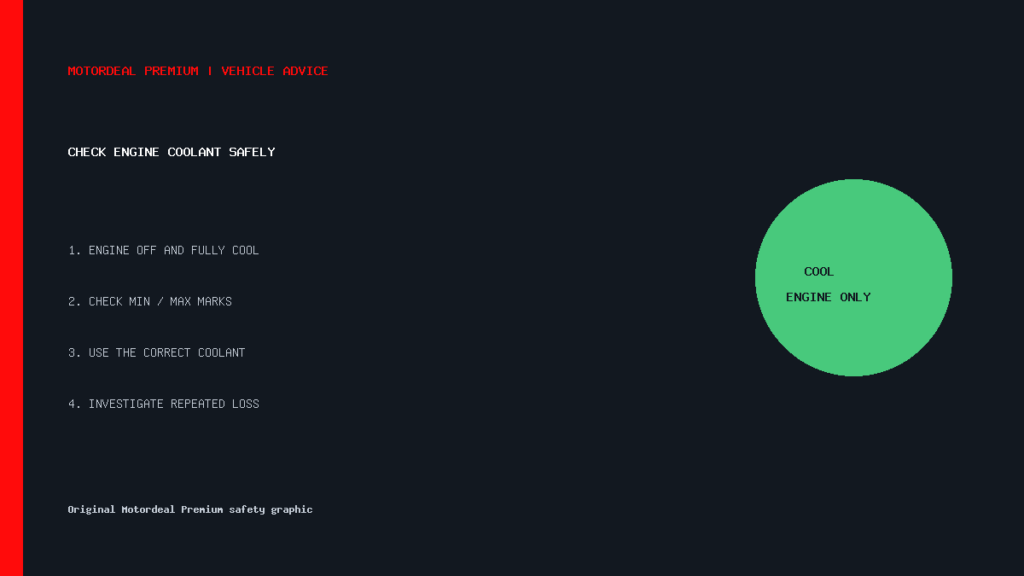
Check engine coolant only when the engine is switched off and fully cool. The level should normally sit between the reservoir minimum and maximum marks. Use only the coolant specification in the owner manual, and never open a hot pressurised cooling system.
Information checked: 7 November 2026.
Why coolant level matters
Engine coolant carries heat away from the engine and helps protect the cooling system against corrosion and temperature extremes. A low level can contribute to overheating and expensive damage, while repeated topping up can hide a leak.
Before you touch the cooling system
Burn warning: hot coolant can be under pressure and may spray out when a cap is opened. Never remove the reservoir or radiator cap while the engine is running or hot. Cooling fans may start automatically, even with the engine off, so keep hands, clothing and tools clear.
Park on level ground, apply the parking brake, switch the engine off and allow it to cool fully. If the temperature warning light is on, steam is visible or coolant is pouring out, do not continue driving. Arrange roadside assistance or qualified inspection.
How to check engine coolant: 6 safe steps
- Read the owner manual. Confirm the reservoir location, checking procedure and exact coolant specification for your model.
- Wait for a cold engine. A cold check gives a safer and more meaningful reading.
- Find the translucent reservoir. Do not confuse it with the windscreen-washer or brake-fluid reservoir.
- Read the level from outside. It should generally be between the MIN and MAX, LOW and FULL, or L and F marks specified by the manufacturer.
- Top up only if the manual permits it. Use the correct premixed coolant or specified mixture. Do not mix coolant types or colours as a shortcut.
- Refit the cap securely. Clean spills immediately and keep coolant away from children and animals.
Can you use tap water?
Do not assume tap water is suitable. Mineral content can encourage deposits, and water alone does not provide the protection of the correct coolant. Some vehicles require ready-mixed coolant, while others specify concentrate mixed with distilled or demineralised water.
When a low level needs a workshop
- The level drops again soon after topping up.
- You see coloured fluid, wet hoses or crusty residue around cooling-system parts.
- There is a sweet smell, steam, overheating or a temperature warning.
- The cabin heater suddenly blows cold while the engine is hot.
- Oil looks milky, coolant looks oily, or persistent white exhaust smoke appears.
These symptoms can have several causes. Do not open, pressure-test or bleed a hot cooling system yourself. Diagnosis and repairs beyond a simple cold-level check belong with a qualified technician.
Buying a used car? Include coolant in the inspection
On a cold vehicle, inspect the coolant level and look for staining or dried residue, but treat this as one item in a broader inspection. Browse our current showroom, review finance options, request a trade-in assessment, or contact our team.
For practical South African motoring checks, follow @motordeal_premium and @motordealpremium on Instagram.
Quick questions
Should coolant be checked hot or cold?
Cold. A hot system can be pressurised and dangerous, and the level changes as coolant expands.
Is coolant colour enough to identify the correct type?
No. Similar colours can use different chemistries. Match the specification in the owner manual.
What if the reservoir is empty?
Do not assume a top-up makes the car safe to drive. An empty reservoir may indicate a significant leak or overheating event. Let the vehicle cool and arrange professional inspection.
Sources
- Ford South Africa: checking and adding engine coolant
- Toyota South Africa dealer car-care guidance
- Automobile Association of South Africa: pre-trip inspection
Share this guide with another driver and follow Motordeal Premium on Facebook for useful vehicle advice.