How to Check Brake Fluid Safely in South Africa
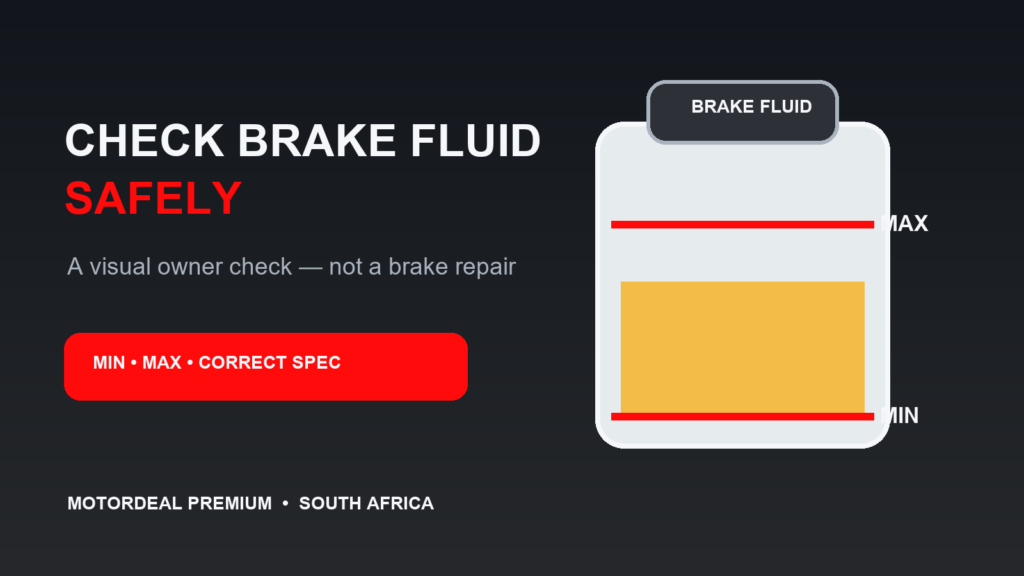
If the brake-fluid level is below MIN, keeps dropping, or the brake warning light is on, do not simply top it up and continue driving. Park safely and have the braking system inspected. A lower level can accompany brake-pad wear, but a sudden or continuing drop may indicate a dangerous leak.
Information checked: 8 November 2026. This is a visual owner check, not a substitute for the vehicle manual or a qualified brake inspection.
What brake fluid does
Brake fluid transfers pedal force through the hydraulic system to the brakes at the wheels. Safe operation depends on the correct fluid, a sealed circuit and proper maintenance.
Safety warning: Do not drive if the pedal feels soft or sinks, braking is reduced, fluid is visibly leaking, or a red brake warning remains illuminated. Arrange professional assistance. Never bypass ABS, stability-control or brake warning systems.
How to check brake fluid safely
- Park on firm, level ground. Switch off, apply the parking brake and let the engine bay cool.
- Read the owner manual. Confirm the reservoir location, checking method and specified fluid. Some vehicles require a workshop procedure.
- Identify the reservoir. It is commonly a small translucent container near the rear of the engine bay, but locations vary. Confirm the cap symbol or wording.
- Clean around it. Wipe exterior dust away so contamination cannot enter.
- Check without opening. Read through the container. The level should normally be between MIN and MAX. Use a torch from the side if needed.
- Do not diagnose by colour alone. Colour varies and cannot replace the specified interval or a proper moisture and boiling-point test.
- Record the result. If it is near MIN, arrange an inspection rather than repeatedly topping up.
Should you top it up?
Only top up if the manual permits it, you know the exact specification, and there is no leak or abnormal pedal feel. Fluid can fall slightly as pads wear. Filling to MAX without understanding why may mask wear and can cause overflow when new pads are installed.
Never guess the fluid type. DOT 3, DOT 4, DOT 5.1 and manufacturer-specific low-viscosity fluids are not interchangeable merely because containers look similar. Silicone DOT 5 is fundamentally different from common glycol-based fluids. Follow the exact manual and cap specification.
If topping up is appropriate, use a new sealed container, avoid paint contact and refit the cap immediately. Brake fluid absorbs atmospheric moisture; an old opened bottle is a poor choice.
Stop and get help when
- The level is below MIN or the reservoir appears empty.
- The level has fallen noticeably.
- There is wetness near a wheel, hose, master cylinder or under the car.
- The red brake warning stays on after releasing the parking brake.
- The pedal is soft, unusually hard, or slowly sinks.
- The car pulls strongly, takes longer to stop or develops grinding sounds.
Do not crawl under an unsupported vehicle. Leak tracing, brake bleeding, ABS hydraulic work and flushing belong with a suitably equipped technician.
How often should brake fluid be changed?
There is no universal interval. Follow the time or distance in the manufacturer service schedule, whichever comes first. South African heat, towing and mountain driving increase brake demands, but the official schedule remains the controlling guidance.
Used-car inspection tip
A reservoir level is only one clue. Ask for service records, observe warning lights during start-up, and arrange an independent mechanical inspection. A freshly topped-up reservoir does not prove the fluid is healthy or the system leak-free.
Browse our current showroom, explore vehicle finance, or request a trade-in assessment.
Quick checklist
- Level ground; engine off and cool.
- Confirm the reservoir in the manual.
- Read through the container; avoid opening unnecessarily.
- Level between MIN and MAX.
- No leaks, warning lights or abnormal pedal feel.
- Use only the exact specified fluid.
- Investigate repeated loss; do not keep topping up.
Sources
- Ford South Africa: How to check brake fluid
- Bosch Automotive Aftermarket South Africa: Brake fluid
- Your vehicle official owner manual and maintenance schedule.
For practical SA motoring guidance, follow @motordeal_premium and @motordealpremium. Share this checklist with a new driver.
Follow Motordeal Premium on Facebook or contact our team.