South Africa’s Drink-Driving Limit: What the Law Says Now
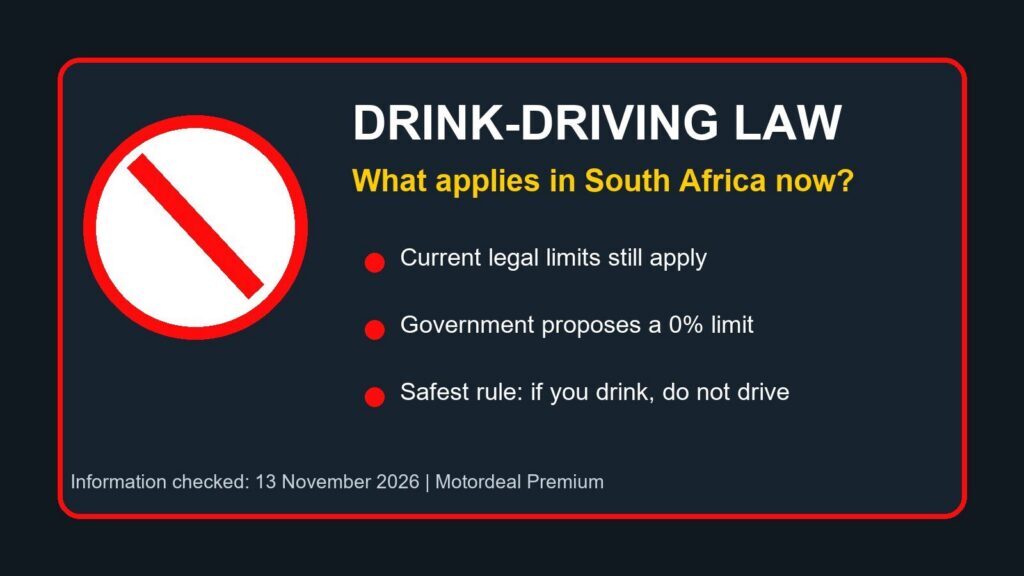
Answer first: South Africa has not yet changed to a zero-alcohol driving limit. As checked on 13 November 2026, the existing statutory limits still apply, while government is pursuing an amendment to make the limit 0%. The practical safety rule is simpler: if you drink, do not drive.
Information checked and updated: 13 November 2026. This is general road-safety information, not legal advice.
What is the drink-driving limit in South Africa now?
The current threshold for an ordinary driver is below 0.05 g of alcohol per 100 ml of blood, or below 0.24 mg per 1 000 ml of breath. Professional drivers face stricter thresholds: below 0.02 g per 100 ml of blood or below 0.10 mg per 1 000 ml of breath.
These figures are legal thresholds, not a safe allowance. Alcohol affects people differently according to body size, food, medication, drink strength, time and other factors. Counting drinks is therefore not a dependable way to decide whether you can drive.
Has the proposed 0% alcohol limit become law?
No—not as at 13 November 2026. Transport Minister Barbara Creecy said government was seeking the required legal, impact-assessment and Cabinet approvals for an amendment to section 65 of the National Road Traffic Act. The stated aim is a clear zero-percent blood-alcohol policy.
That proposal matters, but a policy announcement is not the same as an enacted law. Until an amendment formally takes effect, motorists should not circulate messages claiming that the limit has already changed.
Why “one drink is fine” is risky advice
- A standard-looking glass may contain more than one serving.
- Alcohol absorption and elimination vary substantially between people.
- Coffee, cold showers and fresh air do not rapidly remove alcohol from the body.
- You may still be impaired the next morning after heavy drinking.
- Being below a numeric threshold does not guarantee alertness or safe judgement.
What to do before a social event
- Choose the driver before the first drink. The designated driver should stay alcohol-free.
- Arrange a lift or e-hailing trip in advance. Confirm collection points and phone battery charge.
- Stay over if transport is uncertain. Do not wait until late at night to improvise.
- Do not let an impaired person drive. Take the keys only where it is safe to do so and arrange transport.
- Never ride with a driver who has been drinking.
What if you are stopped at a roadblock?
Stay calm, stop where directed and cooperate with lawful instructions. Do not attempt to evade a checkpoint. SAPS warns that drivers found over the legal limit can be arrested and charged. Consequences can include custody, licence consequences, a criminal record and insurance complications.
If you are buying a safer, more dependable vehicle for family travel, browse our current showroom or read about vehicle finance options. No vehicle technology can compensate for an impaired driver.
The Motordeal Premium view
Editorial viewpoint: motorists should not treat a legal alcohol threshold as a target. A zero-drink decision before driving is easier to understand, easier to plan around and safer for passengers and other road users.
Share this guide with the person who usually plans the lift home. Follow @motordeal_premium and @motordealpremium on Instagram for practical motoring guidance.
Sources
- SAnews: Government pursues strict zero-percent blood-alcohol policy
- SAnews: Government plans to amend section 65
- SAPS: drinking-and-driving guidance and current limit
For vehicle questions, trade-ins or buying assistance, contact Motordeal Premium or start with our trade-in page. Follow the Motordeal Premium Facebook page for updates.