Driving in a Thunderstorm: 9 Safety Rules for South Africa
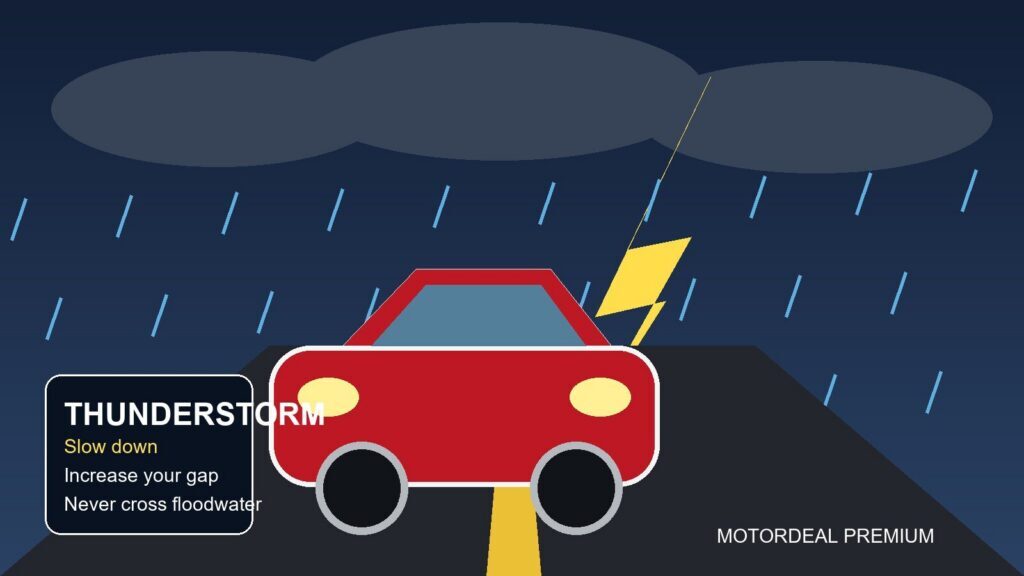
When a thunderstorm hits, slow down smoothly, switch on dipped headlights, increase your following distance and avoid every road covered by flowing or standing water. If visibility becomes unsafe, stop at a safe place away from traffic lanes, trees, low-water crossings and flood-prone ground.
Information checked: 16 November 2026.
What to do when a thunderstorm starts
- Ease off the accelerator. Avoid sudden steering, hard acceleration and abrupt braking.
- Use dipped headlights. They help others see you; daytime running lights may leave rear lights off.
- Leave a much larger gap. Wet roads reduce grip and spray can hide stopped traffic.
- Keep both hands on the wheel. Gusts and standing water can move the vehicle unexpectedly.
- Use wipers and demisting early. Clear the windscreen before visibility becomes critical.
Should you use hazard lights in heavy rain?
Do not drive continuously with hazard lights simply because rain is heavy. They can make your intentions less clear and may interfere with normal indicator use. Use them when your stationary vehicle creates a hazard or an immediate emergency requires them.
Never drive through floodwater
Water can hide a washed-away road, deep potholes, debris or a strong current. A vehicle can lose traction, float or suffer engine and electrical damage. Turn around and use another route. Never move a barrier or follow another driver into a flooded crossing.
Safety warning: If water rises around a stationary vehicle, call emergency services and follow their instructions. Do not enter moving water on foot. Conditions change rapidly, so there is no universally safe crossing depth.
What if the car starts aquaplaning?
Stay calm, look where you want to go and ease off the accelerator gradually. Keep steering inputs small. Do not stamp on the brakes or make a sharp correction. Grip should return as speed falls and the tyres clear the water.
Is a car safe from lightning?
A fully enclosed, hard-topped vehicle generally offers better protection than being outside. Close the windows, avoid touching exposed metal and remain inside until the most intense lightning has passed. An open convertible, motorcycle, bicycle or open vehicle does not offer the same protection.
When should you pull over?
Stop if you cannot clearly see lane markings, nearby traffic or hazards. Choose a proper parking area, service station or location well clear of moving traffic. Avoid trees, unstable structures, bridges, dips and high-speed shoulders unless no safer option exists.
Five checks before summer storm season
- Tyres have legal tread, correct pressure and no visible damage.
- Wiper blades clear the glass without smearing.
- Headlights, brake lights and indicators work.
- The demister clears the windscreen.
- Washer fluid is filled and the battery is sound.
Need a safer, road-ready replacement? Browse our showroom, explore vehicle finance, request a trade-in assessment, or contact the team.
Follow @motordeal_premium and @motordealpremium for more practical guidance.
Sources
- South African Weather Service
- Arrive Alive: driving in flood conditions
- Arrive Alive: driving in heavy rain
- US National Weather Service: lightning and vehicles
Share this guide and join the Motordeal Premium Facebook community.