Buying a Car on Facebook Marketplace? 10 Safety Checks
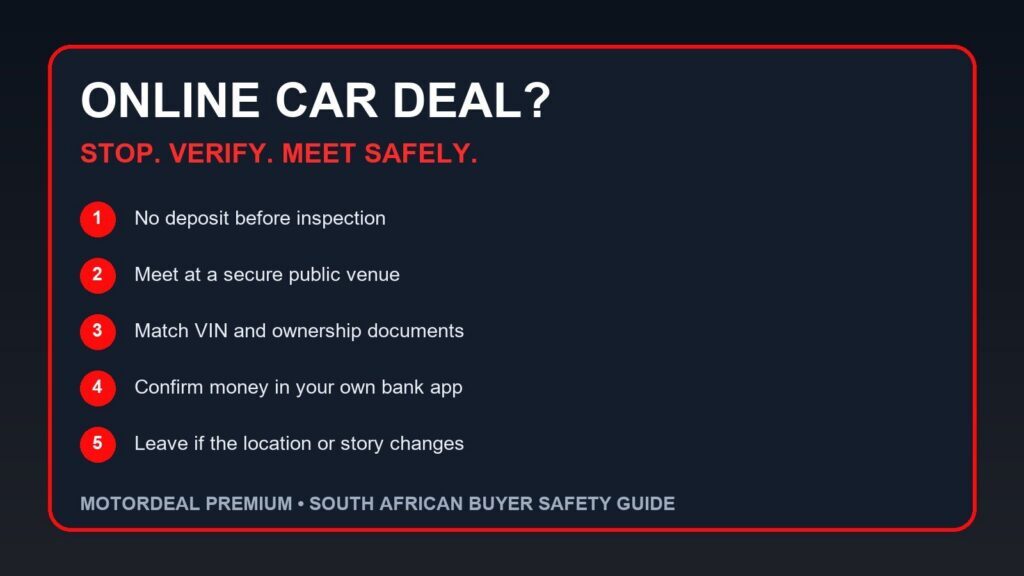
Answer first: Before buying a car advertised on Facebook Marketplace or another classifieds platform, inspect it in person at a secure public venue, verify the seller and vehicle independently, and only pay when the paperwork and transaction are ready to be completed. Never let a bargain price or an urgent seller push you into a deposit.
Information checked: 17 November 2026.
Safety warning: Do not travel to an isolated address, carry a large amount of cash, or confront a suspected scammer. If a meeting feels unsafe or the location changes unexpectedly, leave and report the profile or listing.
Why online car deals need extra checks
An online listing can be useful, but the advert is only a lead—not proof that the seller owns the car. The South African Police Service has warned that criminals use social-media marketplace listings to arrange upfront payments or lure buyers to unsafe meeting points. SAPS advises buyers not to pay before physically inspecting the item and recommends public, well-lit meeting places or a police station.
A car adds further risks: copied adverts, false ownership claims, undisclosed finance, mismatched identification numbers and payment fraud. Use this process before treating a listing as genuine.
10 checks before you buy a Marketplace car
1. Compare the price with the market
Search for the same model, year, specification and approximate mileage across established dealers and classifieds sites. A large unexplained discount is a warning, not a bargain, until verified.
2. Keep the first conversation on the platform
Review the seller profile age, location and activity. Be cautious if the account is new, its name differs from the documents, or the person immediately moves the conversation elsewhere. Save the listing, profile URL and messages.
3. Ask for current proof that the car exists
Request a fresh photo or short video showing the vehicle, registration plate and a harmless detail you nominate, such as the date written on paper next to the car. This can expose copied adverts, but it never replaces inspection.
4. Refuse a viewing at an isolated location
Meet in daylight at a controlled public venue—ideally a reputable dealership, inspection centre or police station. Take another adult, share your live location and arrange your own transport. Leave if the location changes unexpectedly.
5. Inspect the VIN and documents together
Compare the VIN on the licence disc and registration documents with the VIN physically displayed on the vehicle. Locations differ by model. Look for inconsistent fonts, damaged rivets, disturbed labels, grinding or fresh paint around identification points. Do not alter anything yourself.
6. Confirm who is entitled to sell
The seller identity and ownership documents should make sense together. If the vehicle is financed, the bank is an essential party to the sale. Contact it using independently sourced official details, not a number supplied only in a message.
7. Get independent checks
Arrange a mechanical and body inspection by a qualified independent professional. Also use a reputable vehicle-verification service to check identity and risk indicators. TransUnion says verification can help identify stolen or suspect vehicles and confirm vehicle details. Neither check replaces the other.
8. Test-drive safely
Confirm insurance and licence requirements before driving. Check warning lights, service history, tyres, leaks, accident repairs, keys and accessories. If you are not mechanically confident, bring a technician or book a pre-purchase inspection.
9. Do not pay a holding deposit under pressure
Urgency, courier fees and storage stories are common pressure tactics. Never share an OTP, banking password or remote-access code. Enter your bank through its official app or website rather than a link sent by the seller.
10. Control payment and handover
Use a written sale agreement recording the parties, vehicle, VIN, price, known defects, payment method and handover terms. Confirm cleared funds in your own bank app—never from a screenshot, SMS or emailed proof of payment. Complete the required change-of-ownership process promptly.
Red flags that mean walk away
- The price is far below market without a credible reason.
- The seller refuses a physical inspection or independent check.
- The meeting changes to an unfamiliar or isolated area.
- The VIN, disc, documents and seller details do not align.
- You are asked for a deposit or release payment before viewing.
- Payment must go to a different person or changing account.
- The story changes when you ask direct questions.
A safer alternative
A reputable dealership provides a controlled viewing environment, a defined business identity and assistance with documentation and finance. Browse Motordeal Premium’s luxury-value showroom, explore vehicle finance, or use the trade-in page.
For buyer checks and new vehicles, follow @motordeal_premium and @motordealpremium on Instagram.
If you suspect a scam
- Stop and do not send more money.
- Save screenshots, phone numbers, account details, URLs and messages.
- Contact your bank immediately if money or banking information was exposed.
- Report the account and listing to the platform.
- Report the incident to SAPS. For an immediate emergency, use 112 from a mobile phone or 10111.
Need help finding a properly presented vehicle? Contact Motordeal Premium and follow the Motordeal Premium Facebook page.
Sources
- SAPS: warning against online marketplace scams
- SAPS Gauteng: Facebook Marketplace safety guidance
- Banking Association South Africa: bank crime guidance
- TransUnion South Africa: vehicle verification overview