New Motor Industry Code: What South African Drivers Need to Know
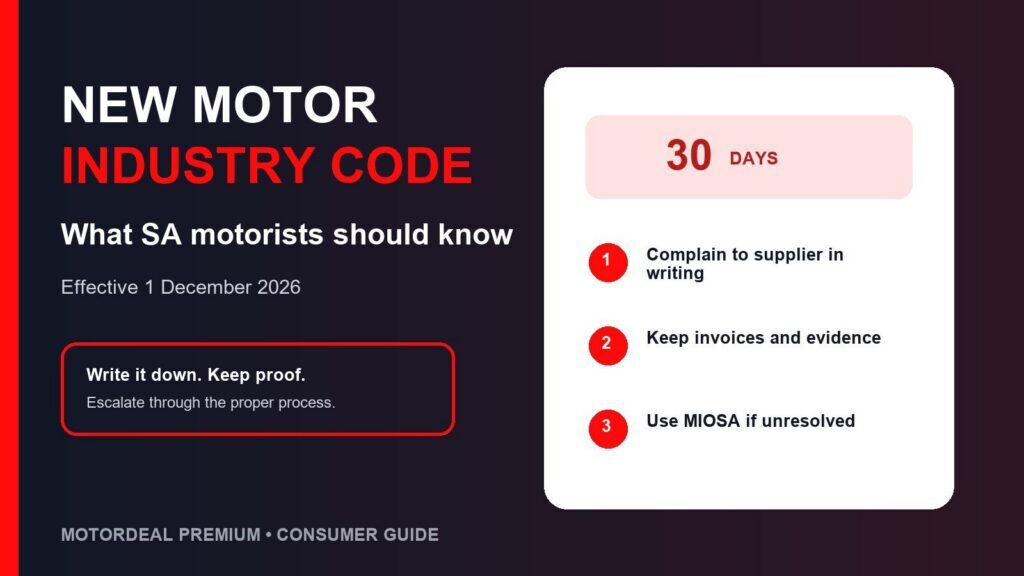
South Africa’s new Automotive Industry Code of Conduct takes effect on 1 December 2026. Motorists should complain to the dealer, workshop or parts supplier in writing, keep their evidence, and approach the Motor Industry Ombud of South Africa (MIOSA) if the supplier process does not resolve the dispute.
Information checked: 17 November 2026. This guide summarises Government Gazette No. 55719, Notice 4265 of 2026. It is general information, not legal advice.
Follow @motordeal_premium and @motordealpremium for practical South African motoring updates.
What changed?
The Minister of Trade, Industry and Competition prescribed the South African Automotive Industry Code of Conduct, 2026 and accredited MIOSA’s alternative dispute-resolution scheme as the industry ombud under the Consumer Protection Act. Published on 11 November 2026, it starts on 1 December 2026, when the 2014 code is withdrawn.
The code covers vehicle, parts and service suppliers. Its definition of a used vehicle includes a previously licensed or registered vehicle and a demonstration vehicle. It does not replace the Consumer Protection Act; it sets industry standards and a process for automotive disputes.
The complaint process in plain English
1. Start with the supplier in writing
Write to the dealer, workshop or other supplier. Identify the transaction, explain what happened, list important dates and state the outcome you want. Ask for written acknowledgement and a reference number.
Suppliers must have an internal complaints process. Schedule 2 says a supplier should provide a substantive written response within 10 business days. The code also requires every reasonable effort to resolve a complaint within 30 days. If testing or another legitimate reason prevents resolution, the consumer should be informed before that period expires.
2. Build an evidence file
Keep the advert, offer to purchase, invoice, finance documents, warranty terms, job cards, reports, photographs, emails and messages. Record dates, mileage and names. Send copies where possible and retain the originals.
Use a short factual timeline. Separate proven facts from suspicions. If a fault affects safety, stop using the vehicle when continued driving may create danger or worsen damage, and obtain model-appropriate advice from a qualified technician or recovery service.
3. Escalate to MIOSA if unresolved
If the supplier process fails, or the supplier states in writing that it cannot resolve the matter, the code directs the consumer to MIOSA. A complainant may also approach MIOSA without first approaching the supplier where doing so would cause or be likely to cause undue harm or prejudice.
The complaint should state the dispute, action requested and expected outcome, with supporting documents. MIOSA should acknowledge receipt within two days. The supplier should respond to MIOSA within 10 days unless it provides acceptable reasons for delay. “Days” means business days, excluding Saturdays, Sundays and South African public holidays.
What MIOSA can—and cannot—do
MIOSA can assess qualifying complaints, request information, engage the parties and use a specialist or technical expert where needed. The code says it should resolve a dispute within 30 days after receiving all information necessary to finalise it.
Important: MIOSA’s recommendations are not automatically binding. If the parties settle and consent, MIOSA may submit the agreement to the National Consumer Tribunal as a consent order. If alternative dispute resolution fails, MIOSA can issue a certificate and the consumer may refer the dispute to the National Consumer Commission.
Jurisdiction limits include disputes reserved for another ombud, certain prescribed claims, class actions, some damages disputes and matters where legal proceedings have already started, unless MIOSA received the complaint first. Suspected criminal conduct may require a separate report.
Seven steps for a stronger complaint
- Identify the transaction: business, branch, dates, vehicle and invoice or job-card number.
- Describe the fault: symptoms, warning lights, conditions and mileage without guessing at a diagnosis.
- List the history: inspection, collection, return and repair dates.
- Attach evidence: documents, photographs and written communication.
- State the remedy sought: inspection, repair, replacement, refund consideration or another lawful outcome.
- Request a written response: use a reasonable date based on the business-day framework.
- Escalate correctly: use MIOSA’s official assistance process if the supplier route fails.
What used-car buyers should do
The code is not a substitute for inspecting a vehicle before purchase. Read the written deal, verify the vehicle’s identity and history, and record material representations in writing. Because a demo is included in the used-vehicle definition, ask about prior registration, mileage, use, condition and warranty coverage.
Browse the Motordeal Premium showroom, review vehicle finance, request a trade-in assessment, or contact the team.
Official sources
- Government Gazette No. 55719: Automotive Industry Code of Conduct, 2026
- Motor Industry Ombud of South Africa
- National Consumer Commission
Quick answers
When does the code start?
It takes effect on 1 December 2026.
Does MIOSA guarantee a refund?
No. The outcome depends on the facts and applicable law, and MIOSA’s recommendation is not automatically binding.
Follow the Motordeal Premium Facebook page and share this guide with a motorist who needs a clear complaint process.