Check Engine Light On? Flashing vs Steady Explained
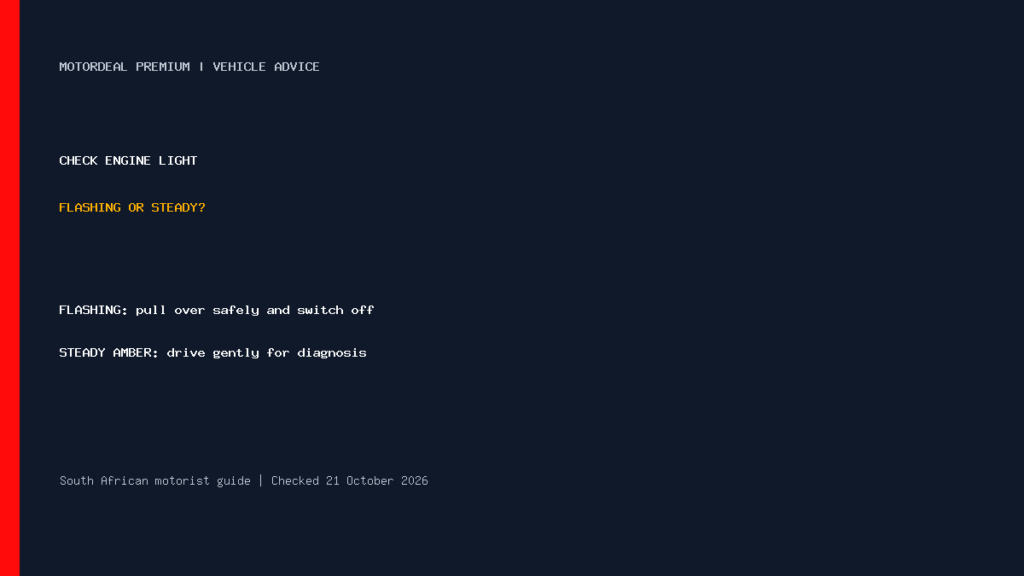
A flashing check engine light is urgent: ease off the accelerator, pull over somewhere safe and switch the engine off. A steady amber light is usually less urgent, but it still needs prompt diagnosis—especially if the car is losing power, shaking, smoking or smelling unusual.
Information checked: 21 October 2026. General guidance only; warning-light behaviour varies by make, model and powertrain.
What the check engine light means
The engine-management lamp appears when the vehicle detects a fault involving the engine, emissions-control system or related sensors. It does not identify one specific failed part. A diagnostic code is a starting point for testing—not proof that the named component must be replaced.
Flashing versus steady: quick decision guide
Flashing amber light
Treat a flashing light as urgent. It can indicate an active misfire capable of overheating and damaging the catalytic converter or diesel particulate filter. Reduce load, avoid hard acceleration, pull over safely and switch off. Arrange roadside assistance or professional advice rather than repeatedly restarting and driving on.
Steady amber light
If the light is steady and the vehicle feels completely normal, drive gently only as far as necessary to obtain a diagnosis. Avoid towing, high revs and hard acceleration. Book the check promptly; do not wait for the next routine service.
Red light or severe symptoms
Stop as soon as it is safe. Switch off if the light is red, the engine shakes badly, power drops sharply, smoke appears, fuel is strongly smelled, temperature is high or oil pressure is low.
Five safe checks
- Move to safety: signal, leave traffic flow and use hazards where appropriate.
- Note symptoms: flashing or steady, colour, noises, vibration, smoke and when it began.
- Check the fuel cap: only when safely parked and the engine is off. A loose cap can trigger an emissions fault on some petrol vehicles.
- Check the manual: manufacturers use different colours, messages and limp-mode strategies.
- Arrange a scan and test: ask for the stored code, freeze-frame data and confirmed diagnosis before authorising parts.
Do not disconnect the battery merely to erase the light, clear codes before they are recorded, use unapproved additives or keep driving a flashing warning. Never bypass emissions or safety systems.
Common causes
Possible causes include ignition-coil or spark-plug faults, air/fuel metering problems, oxygen-sensor faults, intake leaks, injector issues, emissions-system faults, DPF problems and wiring failures. The same warning has many causes, so parts-swapping without testing can waste money.
What to tell the workshop
- When it started and whether it flashes.
- Engine speed, road speed and fuel level at the time.
- Recent refuelling, repairs, battery work or water exposure.
- Rough idle, jerking, smoke, smell or consumption changes.
Buying another vehicle? Browse our Vanderbijlpark showroom, see finance options or request a trade-in assessment.
Sources
- The AA: engine management light guidance
- RAC: engine-management light causes
- AA South Africa: vehicle inspection guidance
For model-specific help, contact Motordeal Premium. Follow @motordeal_premium and @motordealpremium.
Share this guide and follow our Facebook page for South African vehicle advice.