How to Jump-Start a Car Safely in South Africa
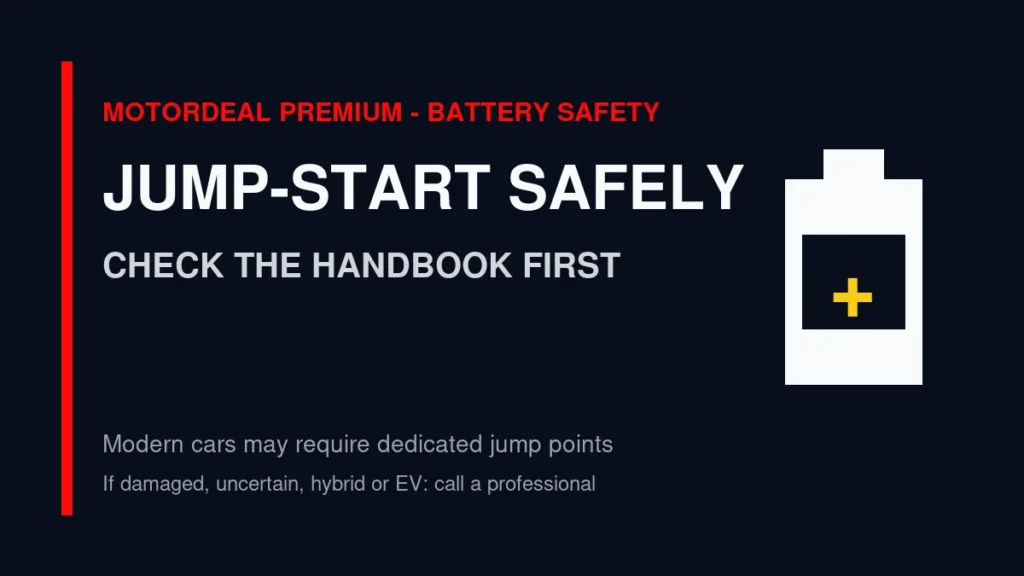
Answer first: A flat 12-volt battery does not make every car safe to jump-start. Before connecting anything, read the vehicle handbook and use only the specified positive and earth points. Do not attempt it if the battery is cracked, leaking, swollen, frozen, smells strongly of sulphur, or if the vehicle is an EV or hybrid unless its manufacturer gives an explicit 12-volt procedure. When in doubt, call roadside assistance.
Information checked: 20 November 2026.
Before you reach for jumper cables
Modern cars can have battery-management systems, remotely located batteries and dedicated jump points. Connecting to the wrong place can damage electronics or create a spark near battery gas. Ford South Africa, for example, says it does not generally recommend owner jump-starting and directs drivers to the specific owner’s manual. That is why the handbook—not a universal internet diagram—must be your first instruction.
Do not attempt a jump-start when:
- The battery case is cracked, bulging, leaking or appears frozen.
- You see damaged cables, loose posts or heavy corrosion.
- There is smoke, unusual heat, a strong rotten-egg smell or signs of fire.
- You cannot identify the manufacturer-approved terminals or earth point.
- Either handbook prohibits it, or the donor vehicle is unsuitable.
- The vehicle is electric or hybrid and you do not have its exact approved 12-volt procedure.
- You are stopped in an unsafe traffic position. Personal safety comes first.
Safe preparation for a conventional 12-volt vehicle
- Move out of danger. Park on firm, level ground away from traffic, flames and cigarettes. Apply both parking brakes and select Park or Neutral as appropriate.
- Check both handbooks. Confirm that jump-starting is permitted, that both systems are compatible and where each connection must be made.
- Inspect the battery area. Stop if you find damage, leakage, swelling, loose terminals or badly damaged leads.
- Switch everything off. Ignitions, lights, climate control, chargers and accessories should be off before connection.
- Use sound equipment. Leads must be correctly rated, insulated and undamaged. Keep jewellery and metal tools away from terminals.
- Follow the handbook sequence exactly. Many vehicles require the final connection to a designated chassis or engine earth point away from the discharged battery, but locations and procedures differ.
- Keep clear while starting. Do not lean over a battery. Stop immediately if cables become hot, spark excessively, smoke or move.
- Disconnect exactly as instructed. The handbook will specify the safe order. Keep clamps from touching each other or moving parts.
Arrive Alive warns that lead-acid batteries can release explosive gas and that poor cable connections may arc. It recommends ventilation, eye and hand protection, keeping sparks and flames away, and following the manufacturer’s instructions for testing, charging and jump-starting.
Why we are not giving one universal cable order
Older advice often presents a four-clamp sequence as if every vehicle were identical. They are not. Some cars have batteries under seats or in boots, some require under-bonnet posts, and some manufacturers specify a dedicated earth point to protect control units. The safe connection order and start procedure for your exact vehicle therefore overrides generic advice.
If the car starts, the job is not finished
- Do not assume the battery is healthy. Arrange a battery and charging-system test.
- If a battery or charging warning remains on, the engine runs poorly, or warning lights appear, stop and get professional assistance.
- Do not repeatedly crank the starter. The AA South Africa warns that continuous cranking can damage the starter, battery and electronics.
- A battery that goes flat again may have reached the end of its life, have a charging fault or have an electrical drain.
- Do not dispose of an old battery in household waste. Use a battery supplier or approved recycling route.
Safer alternatives
A trained roadside technician can test the battery and charging system before deciding whether to jump-start, charge, replace or tow the vehicle. The AA advertises mobile battery diagnosis and jump-start assistance in South Africa. A manufacturer-approved smart charger or jump pack may also be an option, but only when its instructions and the vehicle handbook permit it.
If repeated starting trouble is changing your ownership plans, browse our quality used-car showroom, explore vehicle-finance options, or request a trade-in assessment.
Quick diagnosis: flat battery or something else?
- Rapid clicking and dim lights: often consistent with low battery voltage, but not proof.
- One solid click: could be battery, connection, starter or another fault.
- Normal cranking but no start: the problem may not be the battery.
- No electrical response: check the handbook and seek assistance; a disconnected battery, fuse, immobiliser or other fault may be involved.
Diagnosis by sound alone is uncertain. If you are not confident, avoid trial-and-error connections and call a qualified technician.
Sources
- Ford South Africa: How to jump-start a battery
- Arrive Alive: Safety with vehicle and car batteries
- Automobile Association of South Africa: Battery services
- Automobile Association of South Africa: Vehicle and battery checks
Need help choosing your next car?
Contact Motordeal Premium for straightforward assistance. For practical motoring guides and current stock, follow @motordeal_premium and Motordeal Premium on Facebook.
Prefer the alternate Instagram profile? Follow @motordealpremium for more Motordeal Premium updates.