Traction-Control Light Flashing or Staying On?
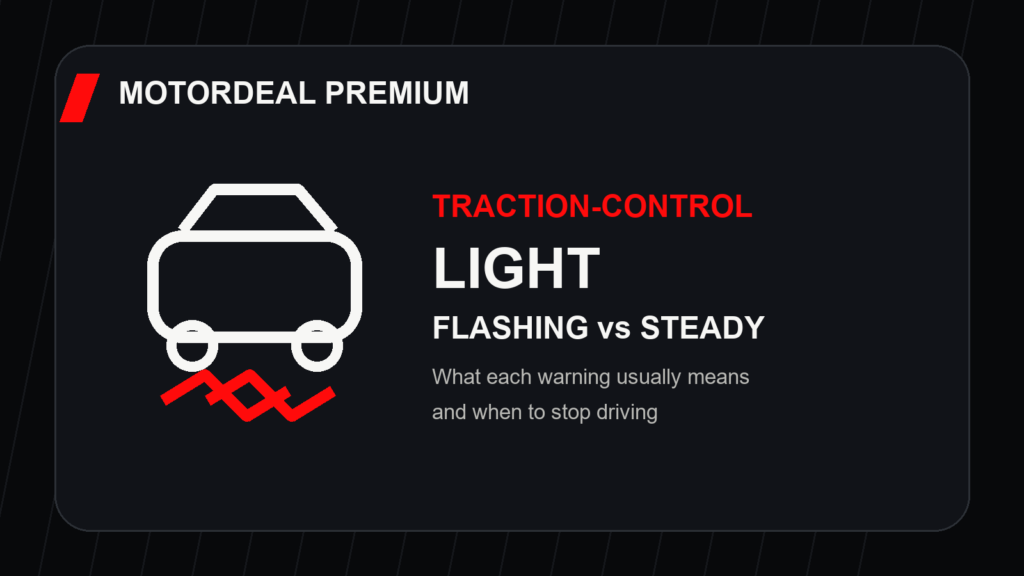
A traction-control or stability-control light that flashes briefly while you accelerate on a slippery road usually means the system is actively helping to limit wheelspin. If the light stays on, the system may have been switched off or may have detected a fault. Ease off the accelerator, drive smoothly and check your owner’s manual before assuming the car is safe to push harder.
Quick answer: Flashing during loss of grip usually means intervention. Steady illumination needs a check: first confirm that traction or stability control was not intentionally disabled; if it remains on, arrange diagnosis. Symbol names and behaviour vary by vehicle.
What the traction-control light means
Modern cars use wheel-speed and other vehicle sensors to detect when a driven wheel is spinning faster than intended. The system can reduce engine torque and, depending on the vehicle, brake an individual wheel to help restore traction. Electronic stability control adds steering-angle and yaw information to help the driver keep the car following the intended direction.
Manufacturers use different names, including TCS, ESC, ESP, DSC, VSC and others. The dashboard symbol often shows a car with wavy skid marks, but your owner’s manual is the authority for your exact model.
Flashing light: the system is usually working
A flashing indicator commonly appears when the tyres are close to losing grip, for example:
- pulling away quickly on a wet road;
- accelerating over loose gravel, sand or mud;
- driving through standing water;
- accelerating hard while turning; or
- using tyres with poor tread, incorrect pressure or mismatched grip.
Your response should be simple: reduce throttle input, keep steering smooth and increase your following distance. The light is not permission to keep accelerating because the electronic system cannot create grip that the tyres and road surface do not have.
Steady light: check whether the system is off
A steady indicator can mean the traction or stability system has been switched off. Some vehicles have a button marked with the skidding-car symbol or wording such as “ESC OFF”. Drivers sometimes press it accidentally while reaching for nearby controls.
- Move to a safe place and stop if road conditions or vehicle behaviour feel uncertain.
- Check whether an OFF indicator is also displayed.
- Consult the owner’s manual for the correct button and restart procedure.
- Do not repeatedly press controls while driving to experiment with the system.
There are limited situations where a manufacturer may allow reduced intervention to help a vehicle move out of deep snow, sand or mud. Follow the vehicle-specific instructions and switch the system back on afterwards. Do not disable it for normal road driving.
When a steady light may indicate a fault
If the indicator remains on after a restart and the system has not been deliberately disabled, the car may have logged a fault. Possible areas a technician may investigate include wheel-speed sensors, wiring, steering-angle calibration, brake-system inputs or the control module. A warning light alone does not identify the failed part, so replacing components without a diagnostic scan can waste money.
Because traction and stability control often share sensors with ABS, you may see more than one warning light. If the ABS, red brake, steering or engine warning light is also on, or the vehicle brakes, steers or accelerates abnormally, stop safely and seek professional assistance.
Can you keep driving?
If the car feels normal and only the traction-control warning remains steady, drive cautiously to a suitable workshop or follow your roadside-assistance provider’s advice. Assume the assistance system may be unavailable: slow down, avoid abrupt steering or acceleration, and leave a larger safety margin—especially in rain.
Do not continue driving normally if the car is unstable, a red brake warning appears, braking changes, the engine loses power severely, or multiple critical warnings are displayed.
Why the light may flash more often than before
Frequent intervention can be a useful clue, even when no fault is stored. Check:
- Tyre pressure: use the vehicle placard, not the maximum pressure printed on the tyre sidewall.
- Tread and condition: inspect all four tyres for worn, damaged or uneven tread.
- Tyre matching: major differences in size, type or wear can change wheel behaviour.
- Road conditions: oil, gravel, rain and standing water can sharply reduce grip.
- Driving input: sudden throttle or steering makes intervention more likely.
If the light begins flashing repeatedly on ordinary dry roads during gentle driving, have the vehicle inspected.
What not to do
- Do not assume electronics can overcome worn tyres or excessive speed.
- Do not fit an unverified wheel-speed sensor based only on the warning icon.
- Do not disconnect the battery merely to erase the light; that can remove useful diagnostic information and may affect other vehicle settings.
- Do not disable stability control for public-road driving.
- Do not ignore other brake or steering warnings that appear at the same time.
A practical South African wet-road check
Before summer travel, inspect pressure, tread and visible tyre damage while the tyres are cold. If rain starts, reduce speed before standing water, avoid sudden inputs and increase your following distance. If you feel the steering go light or the car begins to aquaplane, follow our aquaplaning safety guide. For a warning that stays on, compare it with our ABS warning-light guide and the exact instructions in your owner’s manual.
Sources
- Bosch Mobility: Electronic Stability Program operation
- Kia owner’s manual: ESC operation and indicator behaviour
- Volkswagen: Electronic Stability Control explainer
Published 26 November 2026. This is general safety information; dashboard symbols and permitted procedures vary by make, model and market.