Answer first: test your windscreen wipers with washer fluid before the next storm—not for the first time in heavy rain. If the blades streak, judder, skip, leave an unwiped patch in front of the driver, or have split rubber, clean or replace them. Also confirm that the washer jets spray correctly and the reservoir contains the fluid specified in your owner’s manual.
Information checked: 15 October 2026. Vehicle advice from the Motordeal Premium Editorial Desk.
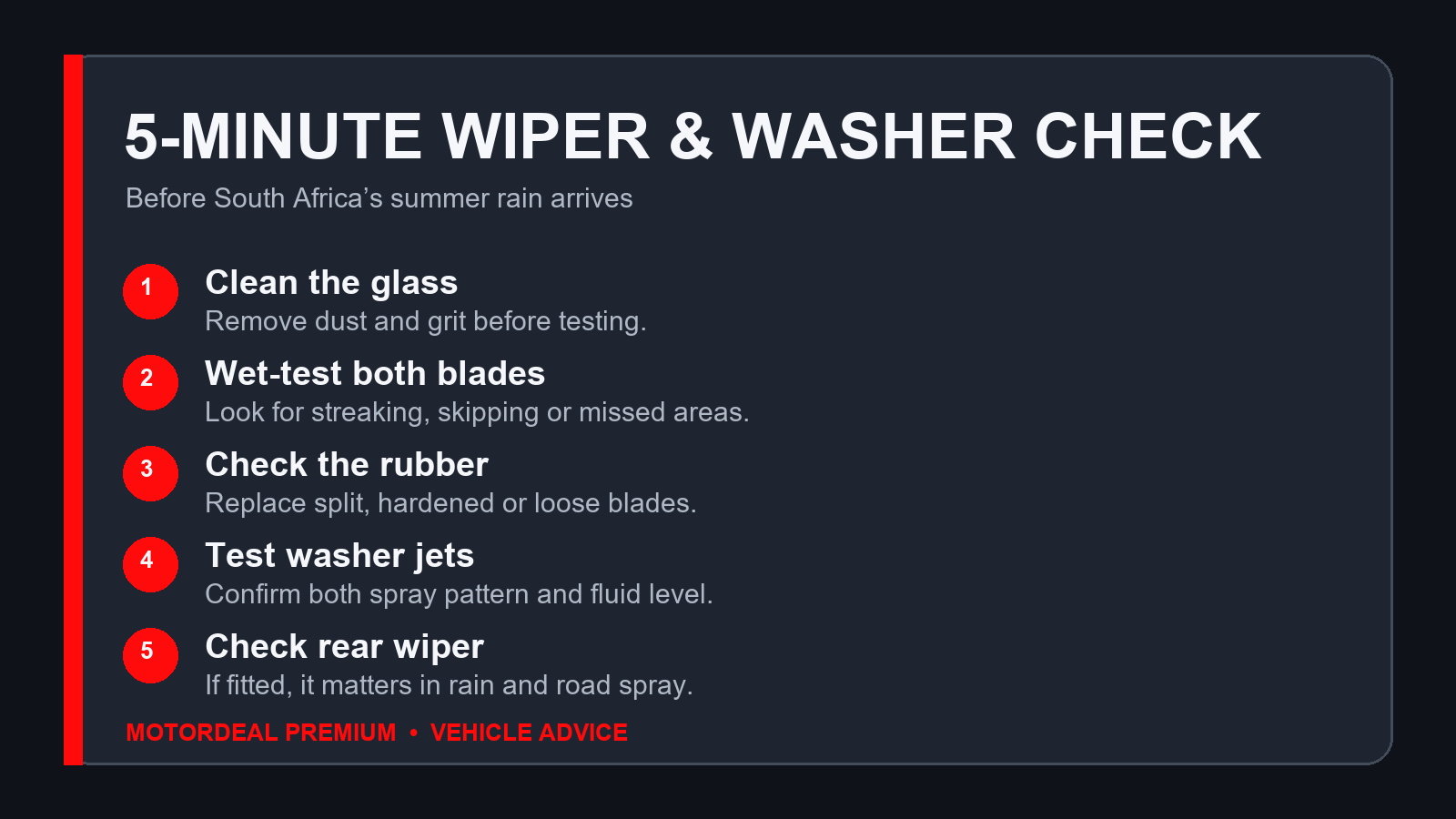
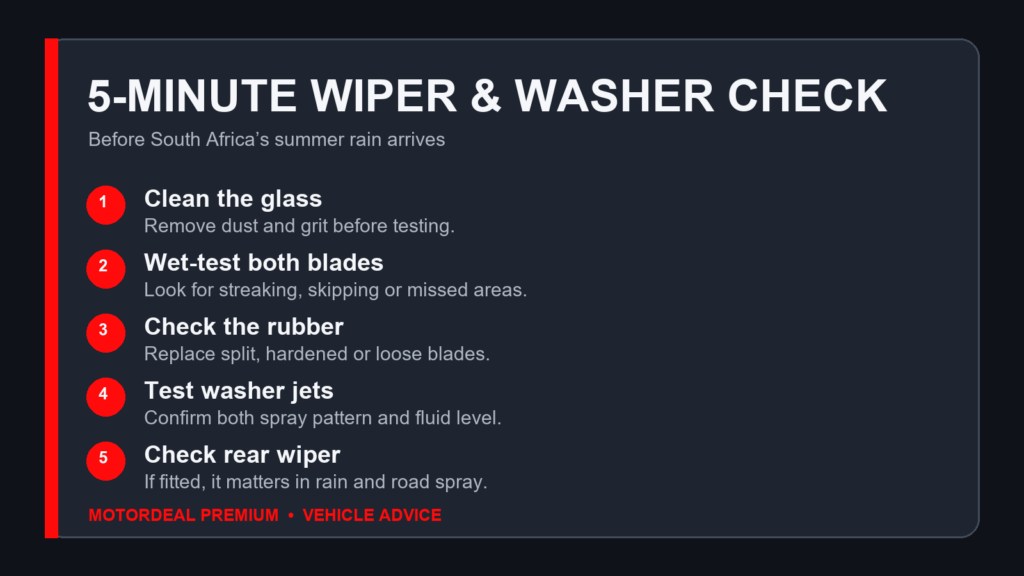
Original Motordeal Premium safety graphic. A wet test reveals problems that a dry visual check can miss.
Why this quick check matters in South Africa
Spring and summer thunderstorms can turn a dusty windscreen into a smeared, low-visibility screen within seconds. The Automobile Association of South Africa advises motorists to keep the windscreen and wipers in good condition and to check both front and rear wipers where fitted. South Africa’s National Road Traffic Regulations also require a wiper that clears the area directly in front of the driver continuously, evenly and adequately.
A blade can look acceptable while parked yet fail under water. Heat, sunlight, dust and long periods without use can harden the rubber edge. That is why the useful check is a controlled wet test, not running dry blades over dusty glass.
How to check windscreen wipers in five minutes
1. Park safely and clean loose dirt first
Park on level ground, switch off the engine and make sure the wipers are in their normal parked position. Remove leaves and loose grit by hand, then clean the windscreen with a suitable automotive glass cleaner and a clean microfibre cloth.
Do not operate dry wipers over sand, mud or heavy dust. Abrasive dirt can scratch the glass and damage the blade edge.
2. Inspect the rubber and blade frame
Lift each arm only as your owner’s manual permits. Look for split, torn, hardened, twisted or loose rubber. Check that the blade is securely clipped to the arm and that the frame or flexible spine is not bent.
Warning: a spring-loaded wiper arm can snap back and crack the windscreen. Support it carefully and place it down gently. Do not leave an unsupported metal arm standing away from the glass.
3. Check washer-fluid level and product compatibility
Find the washer reservoir by using the owner’s manual rather than guessing between under-bonnet caps. Top up only with a washer fluid and dilution appropriate for the vehicle and local conditions. Do not confuse the washer reservoir with coolant or brake-fluid reservoirs.
Avoid household dishwashing liquid unless the vehicle manufacturer explicitly permits it. It may foam, leave residue or be unsuitable for vehicle finishes and washer components. Never mix chemicals whose compatibility is unknown.
4. Perform a wet test
Close the bonnet, start the vehicle if required by its system, and spray washer fluid before operating the wipers. Test low and high speeds, intermittent mode and the rear wiper if fitted. The swept area should clear smoothly without:
persistent streaks or a greasy haze;
chattering, squeaking or skipping;
an unwiped patch directly in front of the driver;
one blade striking the windscreen edge or the other blade;
a blade lifting away from the glass; or
washer jets missing the glass or producing little or no fluid.
5. Decide: clean, replace or book a repair
If the rubber is intact but the wipe is poor, first clean the glass and blade edges with products approved for the vehicle. Replace blades that remain streaky or show physical damage. Match the correct size, connector and blade type for the exact make, model and year.
Book a qualified technician if the motor is slow or intermittent, the arms collide, a spindle is loose, the fuse repeatedly fails, fluid leaks under the vehicle, or the washer pump does not run. Do not force jammed or obstructed wipers.
When should wiper blades be replaced?
There is no single replacement interval that fits every South African vehicle and climate. Inspect them regularly and follow the vehicle and blade manufacturer’s guidance. Replace based on condition and performance, not only age. Strong UV exposure, outdoor parking and dusty roads can shorten useful life.
What to do if wipers fail while driving in rain
Reduce speed smoothly and increase following distance; do not brake or steer abruptly.
Switch on headlights so the vehicle is more visible.
Do not lean out of the window or continue driving with an obscured view.
Move to a safe place off the traffic lane as soon as conditions allow, then stop and use hazard lights where appropriate.
Arrange roadside assistance or repair. Do not attempt an electrical or linkage repair beside moving traffic.
Buying or changing cars? Check visibility equipment too
During a used-car inspection, test the front and rear wipers, every washer jet, the demister and the windscreen for chips or cracks. A small visibility fault can become a serious problem in the first downpour.
Have a rainy-season vehicle question? Join the conversation on the Motordeal Premium Facebook page or send it through our contact page for a future guide.