Cruise Control: When to Use It and When to Switch It Off
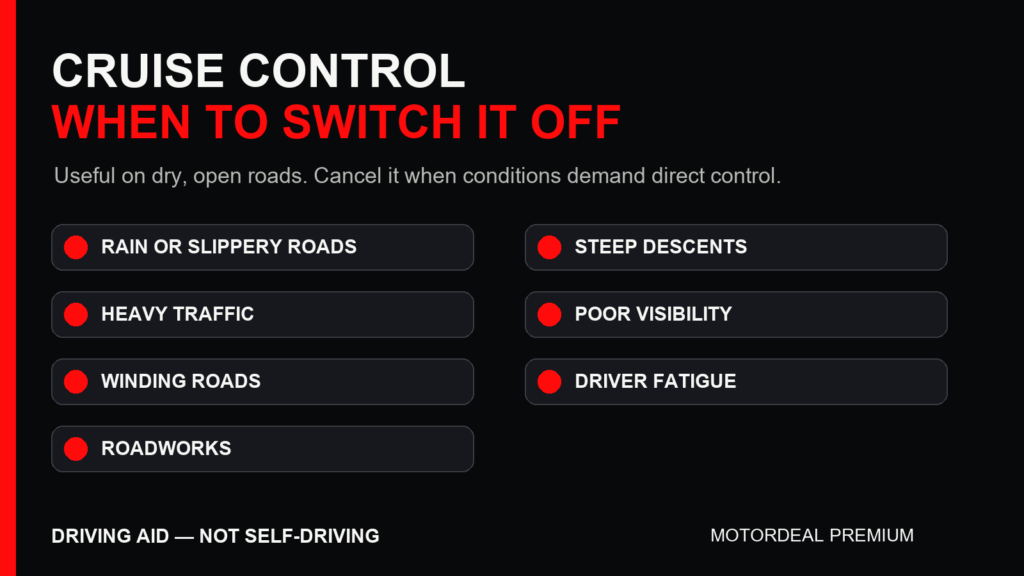
Answer first: Use cruise control on a clear, dry, open road with steady traffic, while staying fully alert and ready to brake. Switch it off in rain, on slippery or winding roads, in heavy traffic, near roadworks, on steep descents, or whenever conditions demand frequent speed changes. Adaptive cruise control can help manage speed and following distance, but it is not self-driving.
Safety guidance checked: 23 November 2026. Controls and system limits differ by vehicle. Your owner’s manual is the final authority for your model.
What cruise control actually does
Conventional cruise control maintains a speed selected by the driver. Adaptive cruise control adds sensors that can adjust the vehicle’s speed to help maintain a selected gap from traffic ahead. Some systems can slow to a stop and move again, but the exact behaviour varies by model.
Ford South Africa describes adaptive cruise control as a system that monitors traffic ahead, slows for a slower vehicle and returns to the set speed when the road clears. Ford also states that driver-assistance features are supplemental and do not replace the driver’s attention, judgement or control.
When cruise control is most useful
- Dry, open highways: long, straight sections with predictable traffic are the best environment.
- Steady traffic flow: the system should not force repeated braking, cancelling and resuming.
- Good visibility: you must be able to see hazards early and assess what the system may not detect.
- Familiar controls: know how to set, cancel, resume and adjust the following interval before the trip.
Keep both feet in a normal driving position, watch the road continuously and remain ready to take over. Cruise control may reduce the need to hold the accelerator at one position; it does not reduce your responsibility.
Seven times to switch it off
- Rain, standing water or slippery roads: Volvo’s official guidance warns against cruise control on wet or slippery roads. A fixed-speed command can be unhelpful when grip changes suddenly.
- Heavy or stop-start traffic: even adaptive systems have detection limits. Drive manually when traffic behaviour is unpredictable.
- Winding roads and sharp bends: select speed yourself so it suits each corner, sightline and surface.
- Roadworks, pedestrians or roadside activity: changing lanes, temporary markings and people near the carriageway require direct control.
- Steep descents: cruise control may not hold the set speed on a steep downhill. Select an appropriate gear and brake safely according to the owner’s manual.
- Poor visibility: mist, smoke, glare or heavy rain can limit both the driver and the vehicle’s cameras or radar.
- When you feel tired: cruise control is not a fatigue countermeasure. Stop somewhere safe and rest if you show drowsy-driving warning signs.
Adaptive cruise control is not a collision-avoidance guarantee
Adaptive cruise control may fail to detect or respond as you expect. Official Volvo guidance notes that systems can have difficulty with small vehicles, motorcycles, stationary objects, sudden braking and demanding road or weather conditions. Sensor designs differ, so do not assume your car has the same capabilities as another model.
Keep a safe following distance even when the display shows that a gap has been selected. Increase the gap for poorer visibility, heavier loads, towing and any condition that increases stopping distance. If the vehicle ahead brakes sharply, act immediately rather than waiting to see what the system will do.
Be careful with the Resume button
Resume normally commands the car to return to the previously stored speed. If traffic has slowed or the limit has changed, that stored speed may now be inappropriate. Volvo warns that speed can increase significantly after resume is selected.
Before pressing Resume, check the current speed limit, traffic, road surface and stored set speed. When uncertain, set a new speed rather than restoring an old one.
Before a long trip: a 60-second cruise-control check
- Read the cruise-control section of the owner’s manual.
- Identify the Set, Cancel, Resume and distance controls.
- Clean the windscreen and the sensor areas identified by the manufacturer.
- Check that no warning message says the system is unavailable.
- Practise activation and cancellation on a safe, familiar road.
- Confirm how braking, clutch use or gear changes affect the system.
- Never test unfamiliar controls in dense traffic.
If an adaptive system behaves unexpectedly, cancel it, drive manually and arrange diagnosis if a warning persists. Do not cover, paint or modify a radar or camera area identified in the owner’s manual.
Frequently asked questions
Does cruise control save fuel?
It can help maintain a steadier speed on a suitable open road, but fuel use still depends on speed, terrain, traffic, load, wind and the vehicle. It may command more throttle than a careful driver would use on rolling hills.
Can I use cruise control in the rain?
The safest general rule is to switch it off when the surface is wet or slippery. Follow the restrictions in your owner’s manual.
Does adaptive cruise control steer the car?
Not necessarily. Adaptive cruise control normally manages speed and distance. Lane-centring or steering assistance is a separate feature, even when the systems work together.
Can cruise control prevent speeding?
No. The driver must choose a lawful speed and adjust it when limits or conditions change. Downhill speed may also increase on some vehicles.
For related trip preparation, read our guides to drowsy-driving warning signs, packing a car safely, and driving in strong winds.
Sources
- Ford South Africa: What is Adaptive Cruise Control?
- Ford South Africa: Adaptive Cruise Control user guide and limitations
- Volvo Cars: cruise-control use and deactivation guidance
- Volvo Cars: adaptive cruise-control function and limitations
Looking for your next road-trip car? Browse Motordeal Premium’s current vehicles, explore vehicle-finance options, or request a trade-in assessment.