Car Loses Power While Driving? What to Do Safely
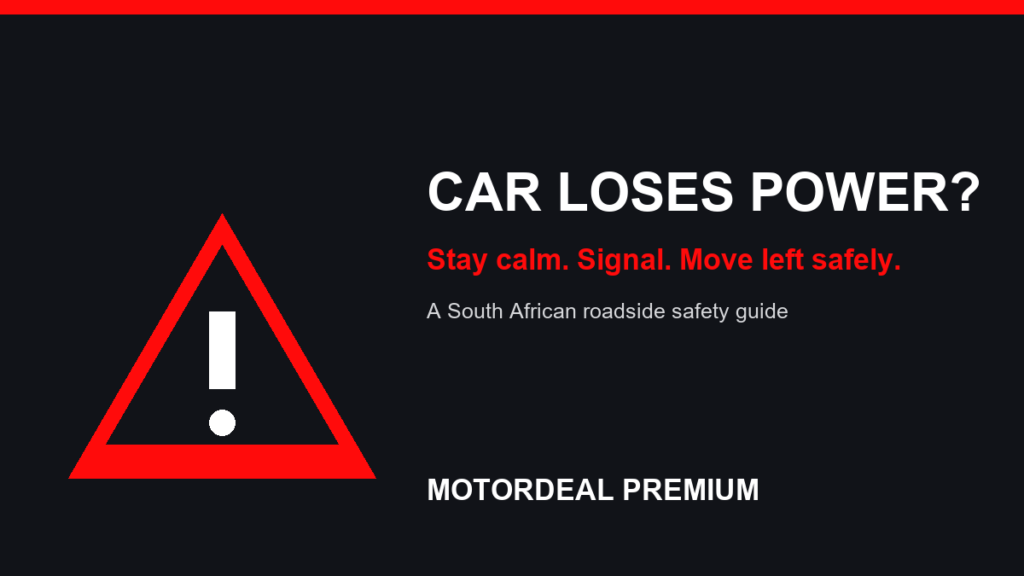
If your car suddenly loses power while moving, keep steering, switch on the hazards, avoid abrupt braking and guide the vehicle towards the left shoulder or another safe stopping place. Do not turn the ignition fully off while moving. Once safely stopped, secure the vehicle, keep people away from traffic and call roadside assistance.
This guide was information-checked on 2 November 2026, after the National Consumer Commission announced a South African Toyota RAV4 PHEV recall involving a possible loss of motive power at higher speed.
What loss of power can feel like
The accelerator may stop responding normally, the vehicle may enter reduced-power or fail-safe mode, warning lights may appear, or the engine or hybrid system may shut down. The car can still have momentum even when it is no longer driving the wheels normally.
Important: steering and braking may feel heavier if assistance is reduced. Use smooth, deliberate inputs and allow more stopping distance.
What to do if the car loses power while driving
- Stay calm and keep both hands on the wheel. Look well ahead and maintain your lane while assessing traffic.
- Switch on the hazard lights. Signal left when safe.
- Avoid sudden steering or braking. Let the car slow progressively unless emergency braking is needed to prevent a collision.
- Move left to a safe stopping area. Prefer a shoulder, emergency lane, lay-by or service station. Do not stop in a live lane unless the car cannot move farther.
- Keep the ignition in its normal running position while moving. Never remove the key or select a setting that could lock the steering.
- After stopping, apply the parking brake and select Park or a suitable gear. Keep the hazards on.
- Call roadside assistance. Give your road, direction of travel, nearest landmark and whether you are blocking traffic.
Protect people after stopping
On a motorway or busy road, personal safety comes before diagnosis. When safe, exit on the side away from traffic and wait behind a barrier or well clear of the roadway. If leaving would be more dangerous, remain belted inside and call emergency services. Use a warning triangle only when it can be placed without walking into fast traffic.
Should you restart the car?
Only consider one restart after you are safely off the road and the vehicle handbook permits it. Do not repeatedly cycle the ignition, disconnect the battery or clear fault codes.
Do not restart or drive if you smell fuel, see smoke or flames, notice leaking fluid, hear severe mechanical noise, see a red oil-pressure or overheating warning, or the manufacturer says not to drive. Move away and call emergency services if there is a fire risk.
What a technician may investigate
- Fuel-delivery or ignition faults
- Charging-system or battery-voltage problems
- Overheating or low oil pressure
- Electronic throttle, control-unit or sensor faults
- Transmission or driveline failure
- Hybrid or EV propulsion-system faults
- An outstanding recall or software campaign
This is not a diagnosis. Modern vehicles store fault codes and operating data that should be read before parts are replaced.
Check for recalls before driving again
Use the 17-character VIN—not only the model name—to ask an authorised dealer whether a safety recall or service campaign is outstanding. The VIN is commonly visible at the lower windscreen, on a door-pillar label and on registration documents. Do not publish your full VIN online.
On 2 November 2026, the National Consumer Commission reported that 77 RAV4 PHEVs built from 2 April to 3 September 2026 were being recalled because an MG-ECU issue could lead to fail-safe operation or loss of motive power. The stated remedy is MG-ECU reprogramming by an authorised Toyota dealer at no cost.
If your car has similar symptoms, do not assume the same recall or repair applies. Record the warnings, speed and conditions, then arrange professional diagnosis.
Information to give roadside assistance
- Exact location and direction of travel
- Vehicle make, model, registration and propulsion type
- Warning lights or messages shown
- Whether the engine runs and the car can roll
- Any smoke, smells, leaks, heat or unusual noises
- Whether anyone is vulnerable or the car is in a live lane
Buying another car? Check the safety basics
When buying used, ask for service history, confirm recall work and obtain an independent inspection. Browse our showroom, view finance options, or contact Motordeal Premium.
For practical South African motoring guidance, follow @motordeal_premium and @motordealpremium on Instagram.
Save this guide before your next trip and follow the Motordeal Premium Facebook page for more vehicle advice.
Sources
- National Consumer Commission: Toyota RAV4 PHEV recall, 2 November 2026
- Your owner’s manual is the model-specific authority for warning messages, towing, restarting and emergency procedures.