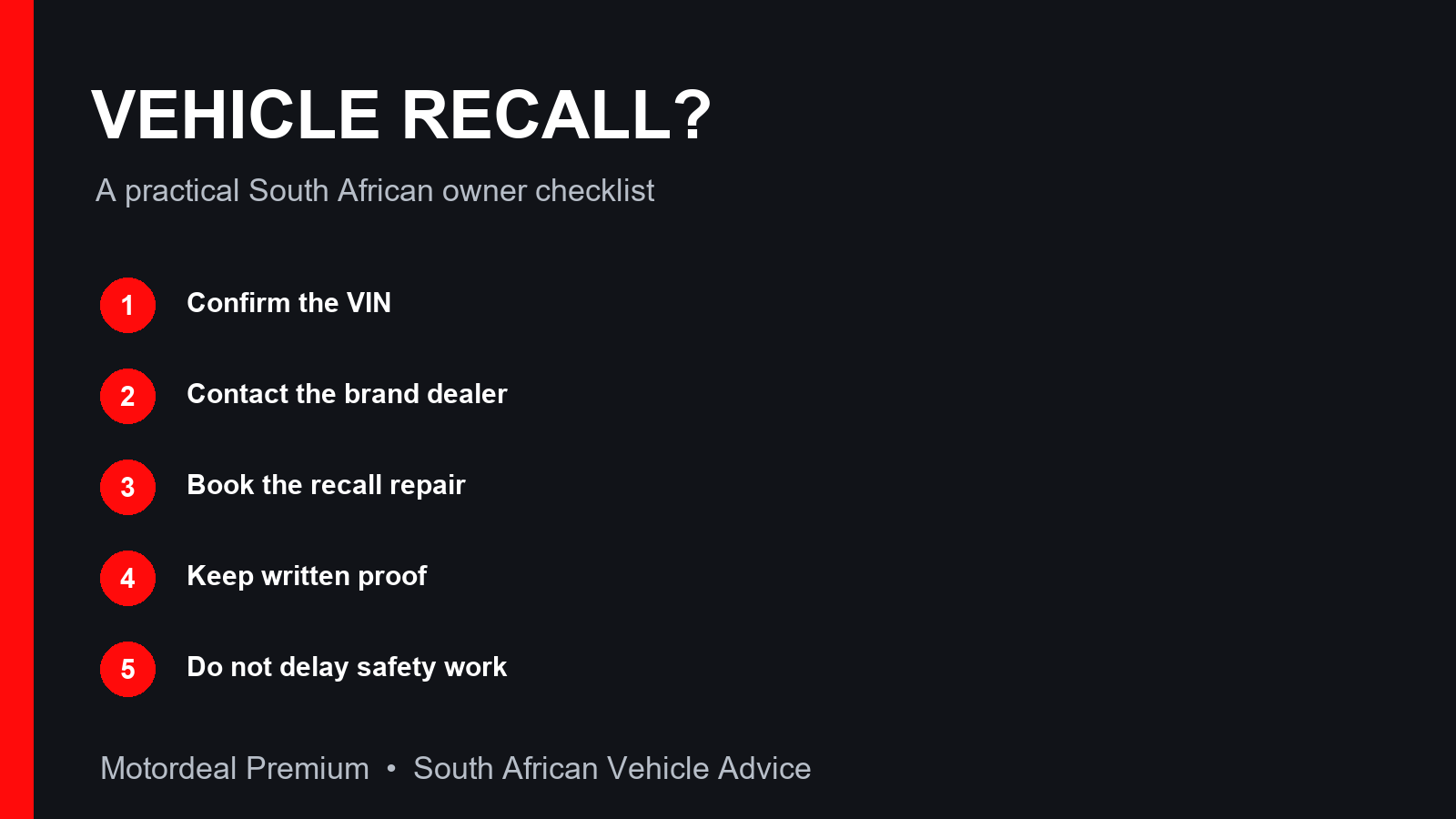
Original Motordeal Premium graphic: five steps to follow when your vehicle is recalled in South Africa.
If your car is recalled in South Africa, confirm whether your VIN is affected, contact an authorised dealer, book the remedy promptly and keep written proof. Official safety-recall repairs for included vehicles are normally completed at no cost.
Information checked: 9 October 2026. Always follow the manufacturer’s campaign instructions.
What is a vehicle recall?
A recall is a formal corrective campaign for a defect or safety risk in a defined group of vehicles. Not every example of a model is necessarily affected: campaigns are commonly limited by VIN, production period, component batch or specification.
Recent National Consumer Commission notices have involved airbags, braking components and fuel-warning systems. The correct remedy is campaign-specific, so do not rely on social-media instructions intended for another vehicle.
Vehicle recall checklist for South African owners
1. Confirm the notice is genuine
Check the manufacturer’s South African website, contact its customer-care line or speak to an authorised dealer. The National Consumer Commission’s media statements also publish recall notices.
Be cautious if a message asks for payment, banking details or a one-time PIN. A genuine recall contact should explain the campaign without requiring payment to an unknown third party.
2. Find and confirm your VIN
The 17-character VIN is commonly shown on the licence disc or vehicle documents, at the lower edge of the windscreen, or on a manufacturer plate. Locations vary by model. Copy it carefully and send it only through a trusted manufacturer or dealer channel. Do not post the full VIN publicly.
3. Ask the dealer four questions
Is my VIN included?
What component and risk are involved?
Is the vehicle safe to drive before repair?
How long will the work take, and must parts be ordered?
If the notice contains an urgent stop-driving or parking instruction, follow it. Otherwise, obtain model-specific guidance instead of guessing.
4. Book the authorised remedy
Use an authorised dealer for the affected brand unless the manufacturer’s written notice says otherwise. Recall work can require campaign-specific parts, procedures and software updates.
Safety warning: Do not probe airbag connectors, bypass warning lights, disconnect ABS or seatbelt systems, or attempt fuel-system or high-voltage repairs. These systems can deploy unexpectedly or fail when needed. A qualified technician must follow the manufacturer’s procedure.
5. Keep proof of completion
Ask for a job card or invoice showing the VIN, campaign reference, completed work, date and dealer, even when the balance is R0. Keep it with the service history for future sale or trade-in.
What if you bought the car used?
Recall eligibility is generally linked to the affected vehicle, not only its first owner. Give the manufacturer your current contact details. When buying used, ask whether outstanding campaigns were checked and request supporting records.
Ask the dealer to record your VIN and booking request, request written confirmation of the next step, and ask whether the vehicle may be driven while you wait. Keep dates, names and reference numbers. Escalate unresolved delays to the manufacturer’s South African customer-care team.
Complete outstanding safety work where possible and disclose unresolved recall information honestly. A completed job card strengthens the vehicle record. For help with your next move, contact Motordeal Premium.
Not always, but the issue deserves action. Follow the exact guidance for your VIN and ask whether driving restrictions apply.
Should I pay for official recall work?
Official safety-recall remedies for included vehicles are normally performed at no cost. Confirm this before work begins and separate recall work from unrelated maintenance you approve.
Can an independent workshop clear the recall?
An official campaign usually needs to be completed and recorded through the manufacturer’s authorised process.
Share this checklist with another driver. Follow Motordeal Premium on Facebook for South African vehicle advice.