Haval Jolion Max Price & Specs: Petrol vs HEV vs PHEV
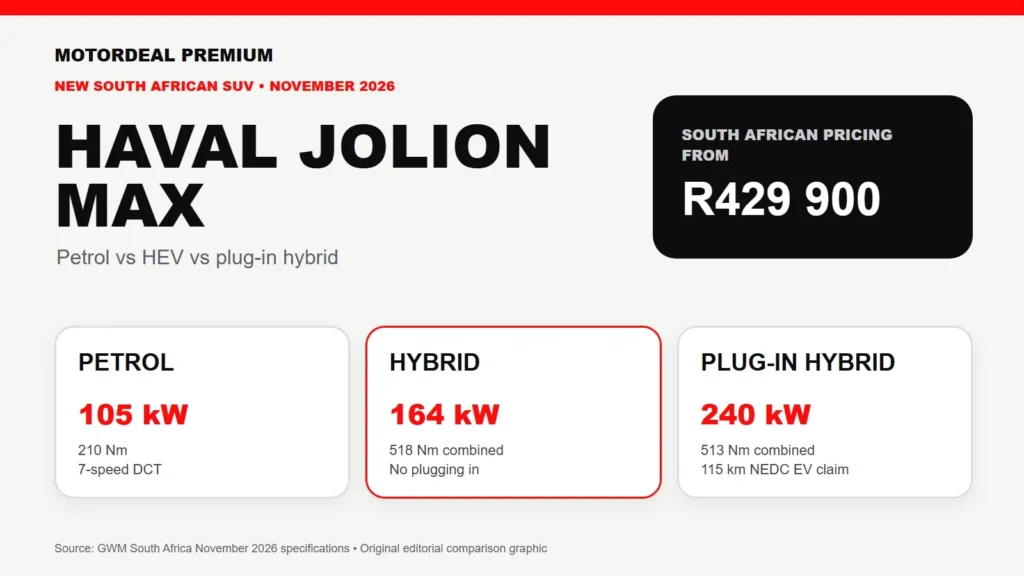
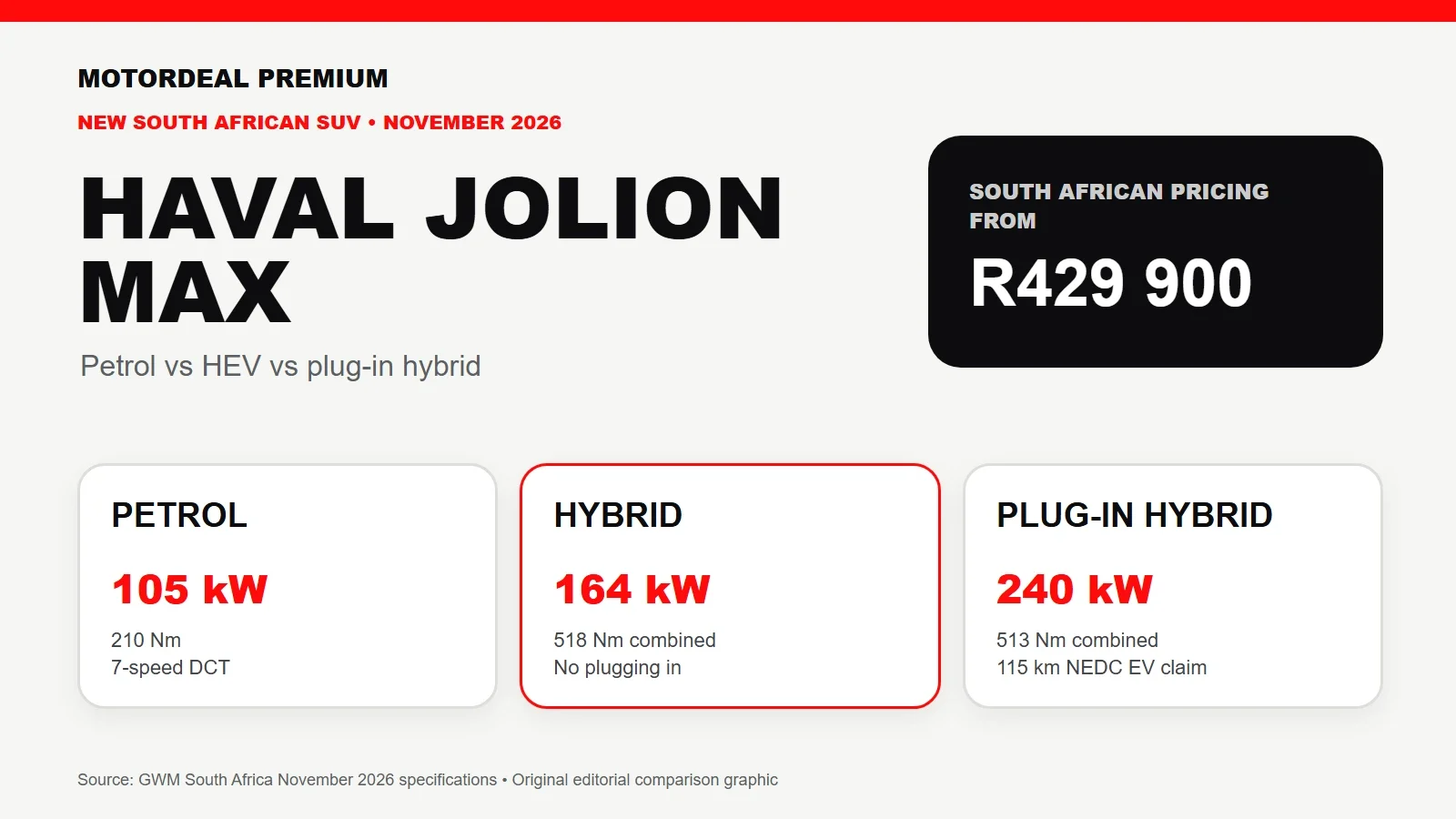
The new Haval Jolion Max has launched in South Africa with five derivatives and three powertrain choices: petrol, self-charging hybrid (HEV) and plug-in hybrid (PHEV). Pricing starts at R429 900 for the 1.5T Premium and reaches R599 900 for the PHEV Super Luxury. The buyer decision is less about “which one is best” and more about whether you can charge at home, how far you drive and which equipment level you need.
Prices and specifications checked on 22 November 2026. Manufacturer specifications and prices can change; confirm the written quotation and derivative specification with a GWM dealer before ordering.
Haval Jolion Max prices in South Africa
- 1.5T Premium DCT: R429 900
- 1.5T Super Luxury DCT: R459 900
- 1.5T HEV Premium DHT: R469 900
- 1.5T Ultra Luxury DCT: R494 900
- 1.5T PHEV Super Luxury DHT: R599 900
The unusual part of the line-up is the HEV price: at R469 900, the hybrid sits below the petrol Ultra Luxury. That makes it important to compare both the powertrain and equipment list rather than assuming every electrified derivative is automatically the flagship.
Petrol, HEV or PHEV: the quick answer
Choose petrol if simplicity and purchase price matter most
The three petrol models use a 1.5-litre turbo engine producing 105 kW and 210 Nm, driving the front wheels through a seven-speed dual-clutch transmission. They are the straightforward choice for buyers who cannot charge at home and want the lowest entry price.
Choose the HEV for urban efficiency without plugging in
The HEV combines a 110 kW petrol engine with a 140 kW electric motor. GWM lists combined system outputs of 164 kW and 518 Nm, using a 1.09 kWh battery. It charges itself through the hybrid system, so there is no charging cable or home wallbox routine.
This suits frequent stop-start driving, but claimed consumption is not a promise of what every owner will achieve. Route, speed, traffic, weather, load and driving style all matter.
Choose the PHEV only if you can use its electric capability
The PHEV combines a 110 kW petrol engine with a 130 kW motor for claimed total outputs of 240 kW and 513 Nm. Its 18 kWh battery supports a claimed 115 km of pure-electric range on the NEDC test cycle.
NEDC is a laboratory standard and should not be treated as a guaranteed real-world distance. Before buying, ask for the usable battery capacity, AC charging rate, charging time from your available supply and a realistic range estimate for your normal route. A PHEV delivers its strongest ownership case when it is charged regularly; running it mainly on petrol means carrying battery mass without consistently using the electric benefit.
Size, boot space and towing
All derivatives measure 4 590 mm long, 1 877 mm wide and 1 675 mm high, with a 2 710 mm wheelbase. GWM lists a 1 500 kg braked towing capacity across the range.
Boot capacity differs by powertrain. The petrol derivatives are listed at 490 to 1 175 litres, while the HEV and PHEV are listed at 440 to 1 125 litres. Buyers who regularly carry prams, luggage or work equipment should test their actual load in the derivative they intend to buy.
Technology and equipment to check on the test drive
The Jolion Max range advertises a 14.6-inch colour touchscreen, wireless Apple CarPlay and Android Auto, a 50W wireless charger, panoramic-view camera technology and driver-assistance features such as adaptive cruise control and lane-keeping assistance. Equipment is derivative-dependent.
Do not judge the interface from a showroom screen alone. Pair your own phone, test the camera in a tight parking space, adjust the climate controls while stationary, confirm which functions require the screen, and check that the assistance settings suit you. Driver-assistance systems support the driver; they do not replace attention or safe control.
Warranty and service-plan headline
GWM’s November 2026 brochure lists a 7-year/200 000 km vehicle warranty, 7-year/unlimited-kilometre roadside assistance and a 7-year/75 000 km service plan. Electrified derivatives have an 8-year/150 000 km high-voltage battery-system warranty. The stated service interval is 12 months or 15 000 km.
Read the full terms before signing. Check exclusions, transferability, service requirements, battery-warranty conditions, roadside-assistance scope and what happens when the kilometre limit is reached before the time limit.
Five questions to answer before choosing a derivative
- Can you charge securely where you park? If not, the PHEV’s value case becomes weaker.
- What is your real daily distance? Compare a normal week—not one ideal commute—with the claimed electric range.
- Which equipment is non-negotiable? The HEV Premium may have the preferred powertrain but not every feature of an Ultra Luxury petrol model.
- What will insurance cost? Quote the exact derivative before paying a deposit.
- What is the total monthly ownership budget? Include finance, insurance, fuel or electricity, tyres, servicing outside the plan and possible home-charging installation.
Motordeal Premium verdict
The Jolion Max’s strongest idea is choice. The petrol Premium opens the range at R429 900, the HEV offers an electrified option without charging, and the PHEV adds substantially more claimed system power and useful electric-only potential for owners who can plug in regularly.
The sensible shortlist starts with your routine. City-heavy driving without home charging points toward the HEV; price-sensitive mixed driving points toward petrol; repeatable daily trips with reliable charging make the PHEV worth investigating. Test the exact derivative, obtain a written specification and compare the total cost—not only the monthly instalment.
Sources
- GWM South Africa: Haval Jolion Max model page
- GWM South Africa: November 2026 Jolion Max specification sheet
- Cars.co.za: South African launch pricing and derivative overview
Compare your options before committing: read our guide on whether an electric car fits your South African routine, review vehicle-finance options, or contact Motordeal Premium.