Steering Suddenly Heavy While Driving? What to Do Safely
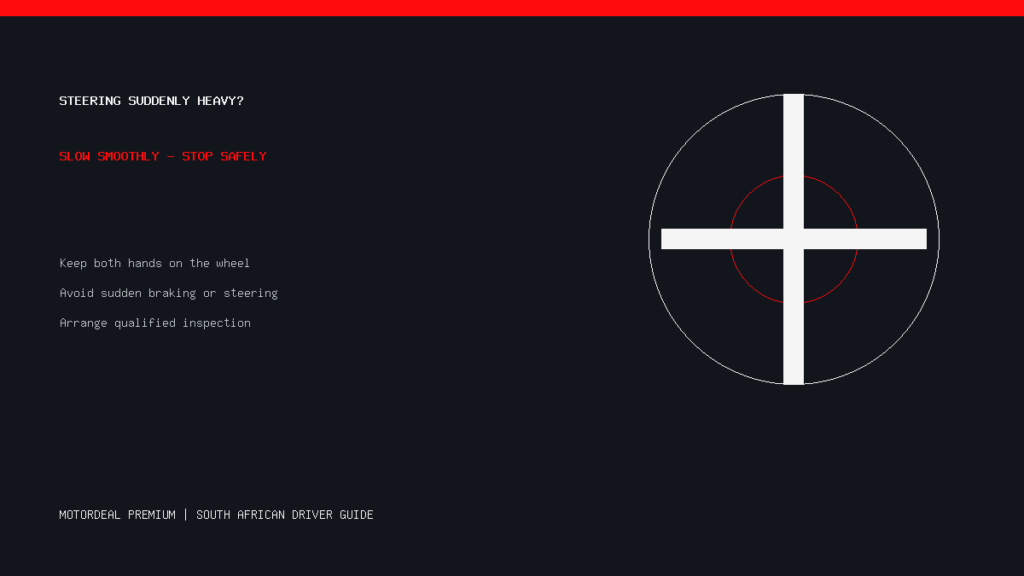
If your steering suddenly becomes heavy while driving, keep both hands on the wheel, reduce speed smoothly, switch on your hazards when safe, and move out of traffic without abrupt steering or braking. Do not continue the journey until the cause has been checked.
Information checked: 5 November 2026. Safety guide by the Motordeal Premium Editorial Desk.
What heavy steering usually means
Modern cars commonly use electric or hydraulic power assistance. If that assistance is reduced or lost, the steering wheel may require much more effort, especially at low speed. The wheels can still respond, but the car may be harder to position safely.
A warning may appear as a steering-wheel symbol or a message such as Power steering fault or Steering assist reduced. The exact symbol and instructions vary by model, so check the owner manual.
What to do immediately
- Hold the wheel firmly with both hands. Expect greater effort, but do not jerk the wheel.
- Ease off the accelerator. Reduce speed progressively. Avoid sudden braking unless needed to prevent a collision.
- Signal and use hazards when appropriate. Check mirrors and blind spots before moving left or toward a safe stopping area.
- Choose a safe place to stop. Get fully out of the traffic lane where possible. On a high-speed road, avoid stopping in a live lane unless the vehicle cannot move.
- Stop the engine only after you are safely stationary. Switching off while moving can remove remaining steering assistance and may affect other systems.
- Arrange roadside help or inspection. If the warning remains, steering is unusually heavy, fluid is leaking, or there are grinding noises, do not drive on.
If you regularly share practical motoring tips, follow @motordeal_premium, @motordealpremium and Motordeal Premium on Facebook.
Safe checks after stopping
1. Check the tyres visually
A severely underinflated or damaged front tyre can make steering feel heavy or pull strongly. Stay clear of moving traffic and do not crawl under the vehicle.
2. Look for an obvious fluid leak
Some cars use hydraulic power steering. A fresh puddle and low reservoir level may indicate a leak. Do not open a hot system or add an unspecified fluid: the correct fluid is model-specific.
3. Note every warning message
Photograph the dashboard while safely parked. Record whether the battery light, temperature warning or steering warning appeared, because this helps the technician diagnose the sequence.
4. Do not repeatedly restart the car as a fix
A restart may temporarily clear an electronic warning, but it does not prove the fault is resolved. If assistance failed while driving, qualified diagnosis is the safer choice.
Possible causes
- Electric power-steering motor, sensor, wiring or control-module fault.
- Low system voltage from a charging-system or battery problem.
- Hydraulic fluid loss, pump failure or a broken/slipping auxiliary belt on relevant models.
- Front-tyre failure, steering linkage damage or impact damage after a pothole or kerb strike.
- Model-specific software faults or an active safety recall.
These are possibilities, not a roadside diagnosis. Steering is safety-critical; repairs should be carried out by a qualified technician using the correct model data.
Can you drive with heavy steering?
Not as a normal journey. Even if the car remains steerable, extra effort can make an emergency manoeuvre difficult. Move only as far as needed to leave immediate danger, then seek professional assistance. Never bypass a steering warning, remove a fuse to suppress it, or modify a safety system.
Before buying a used car
During a viewing, check that the steering warning illuminates during the normal start-up self-test and then goes out. At low speed, turn gently in both directions and listen for groaning, knocking or inconsistent assistance. A proper pre-purchase inspection remains essential.
Browse our showroom, review vehicle-finance options, request a trade-in assessment, or contact Motordeal Premium. For more owner guides and stock updates, follow our Instagram accounts and Facebook page above.
Sources
- NHTSA: steering safety information
- Ford owner-manual portal — model-specific steering-assist warnings and instructions.
- Your vehicle manufacturer owner manual and roadside-assistance guidance.