How to Change a Flat Tyre Safely in South Africa
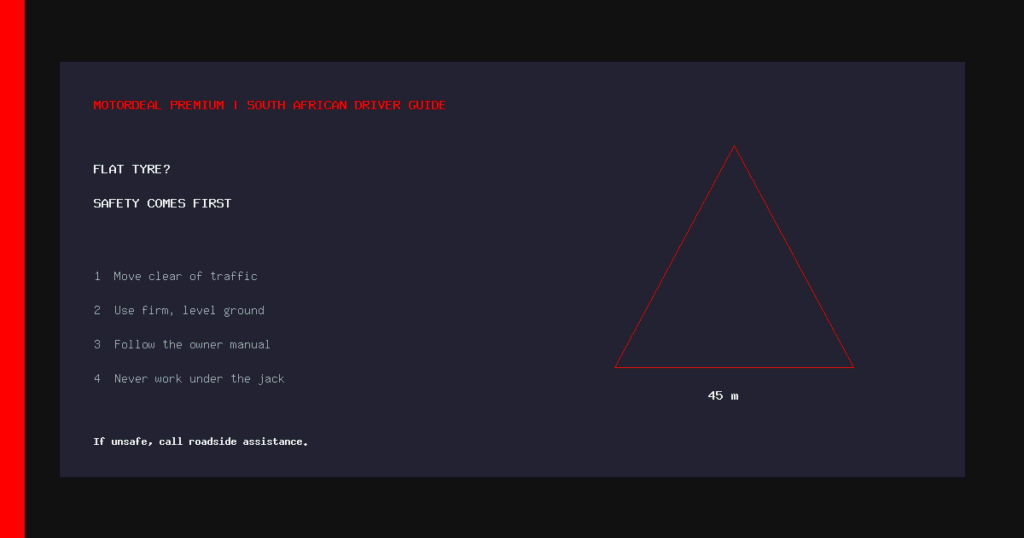
Information checked: 6 November 2026. If a tyre goes flat, your first job is not to fit the spare—it is to get yourself and your passengers out of danger. Only change the wheel where the car is well clear of moving traffic, on firm level ground, and where you can work without standing in a live lane. If the location is unsafe, call roadside assistance.
Safety warning: Never crawl under a car supported only by its emergency jack. Do not improvise a jacking point, work on a slope, or attempt a wheel change beside fast-moving traffic. Your owner manual is the authority for jacking points, spare-wheel limits and tightening.
First decide: is it safe here?
Slow down smoothly, indicate, and move as far from traffic as safely possible. Avoid harsh braking or sudden steering. Stop on a solid, level surface; switch on the hazards; apply the parking brake; select Park in an automatic or first/reverse gear in a manual; switch off the engine; and keep passengers away from the traffic side.
Do not continue when the car is partly in a traffic lane, the shoulder is narrow, the surface is soft or sloped, visibility is poor, you cannot identify the jacking point, the wheel or suspension appears damaged, or you lack a serviceable spare and correct tools. The AA South Africa lists flat-tyre changes among its emergency services.
Place the warning triangle correctly
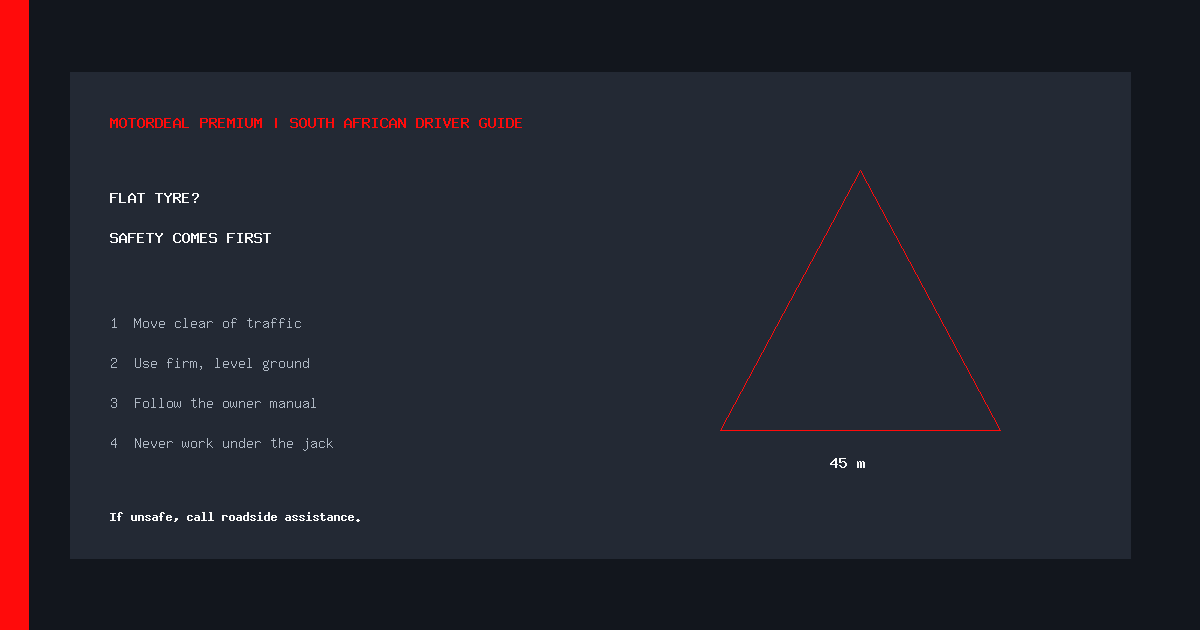
For applicable vehicles, South African road-traffic rules specify placing an approved warning triangle at least 45 metres away in the direction from which traffic approaches, reflective side facing approaching traffic. Only place it if you can do so without walking into danger.
Source: National Road Traffic Regulations, Regulation 214. See our warning-triangle guide.
What you need
- A serviceable spare or manufacturer-supplied temporary spare
- The correct jack and wheel brace
- The locking-wheel-nut key, if fitted
- Your owner manual
- A warning triangle and, ideally, a reflective vest and torch
- Purpose-made wheel chocks, if supplied
Check these items at home, not for the first time on a dark roadside. Check the spare pressure regularly.
How to change a flat tyre: 10 safe steps
- Read the handbook. Find the specified jacking point and spare-release method. EVs, SUVs and air-suspension vehicles may have special instructions.
- Secure the car. Hazards on, parking brake applied, transmission in Park or in gear, engine off and passengers clear.
- Prepare the spare and tools. Keep them from rolling into traffic.
- Remove the wheel cover if needed. Locate the wheel-lock key first.
- Loosen fasteners slightly. With the tyre touching the ground, turn each only enough to break it free.
- Position the jack exactly. Use only the specified jacking point. The floor pan, trim, battery casing and unspecified suspension parts are not substitutes.
- Raise the wheel just clear. Keep your body out from under the vehicle. Stop if the jack tilts or sinks.
- Replace the wheel. Remove the fasteners, fit the spare and refit them finger-tight. Do not place fingers beneath a heavy wheel.
- Lower and tighten correctly. Tighten progressively in the handbook pattern. Use the specified torque with a torque wrench as soon as practical.
- Pack securely. Remove the jack, store the wheel and tools, then retrieve the triangle only when safe.
After fitting a temporary spare
A space-saver is an emergency measure. Follow the speed, distance and inflation limits printed on it and in the owner manual. Have the damaged tyre and rim inspected promptly, and have pressure and wheel-fastener torque verified.
If the car pulls, vibrates, makes a new noise, shows a tyre-pressure warning, or the spare does not sit correctly, stop safely and arrange assistance. After a pothole strike, use our pothole damage checklist.
What if there is no spare?
Run-flat tyres and sealant kits have model-specific limits. Sealant may be unsuitable for sidewall damage, a large cut, damaged rim or a tyre driven while severely deflated. Follow the kit instructions and expiry date, or call for recovery.
Readiness checklist
- Confirm the spare is present, inflated and visibly sound.
- Confirm the jack, brace, towing eye and wheel-lock key are present.
- Locate jacking points safely at home.
- Keep the triangle accessible.
- Save your roadside-assistance number.
Browse our Vanderbijlpark showroom, explore vehicle finance, or request a trade-in assessment. Ask about the spare-wheel arrangement before delivery.
Follow @motordeal_premium and @motordealpremium on Instagram. Share this guide and follow Motordeal Premium on Facebook.
Sources and editorial note
Prepared by the Motordeal Premium Editorial Desk. This is general safety information, not model-specific repair advice. Sources checked: National Road Traffic Regulations, AA roadside-assistance terms, and AA guidance on tyre condition and pressure. Contact Motordeal Premium.